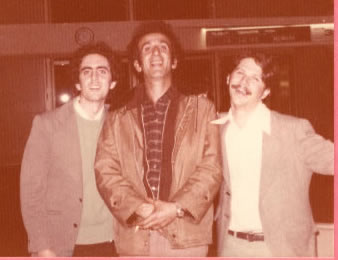
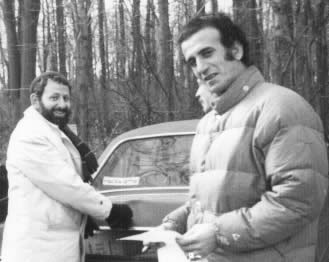
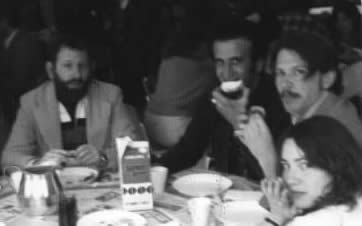
The incredible work, which Jonathan Jacobi invested
in organizing this tour,
whom we would meet and where we would sleep and - sometimes - eat,
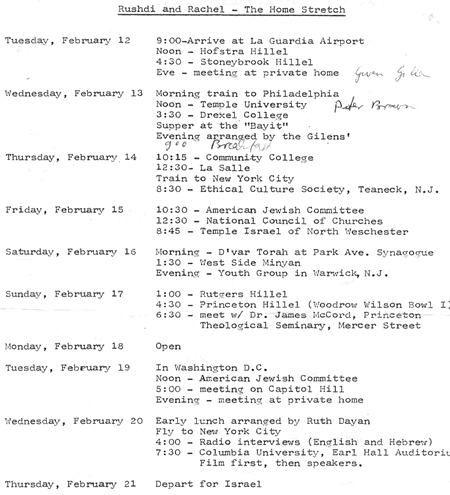
the logistic of transport and planes, etc., can be guessed from the schedule,
which Rushdi and I received at our arrival - with no time for jet-lags etc:
| Jan.21, Mo |
Noon - arrival in Los
Angeles
8:00 PM - Taping of "Odyssey" TV Show (KNBC) |
| Jan.22, Tue |
10:ooAM - Interview with "Valley
News"
6:00 PM - Dinner and parlor meeting at the home of R.&C. Levy |
Jan.23, Wed
(my son's birthday in Israel) |
Noon - Lunch with Earl Warren
Institute of University of Judaism
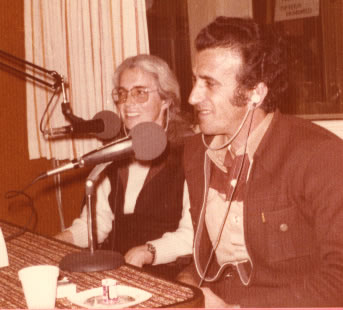
4:00 PM - KPFK, radio show
8:30 - Valley Beth Shalom, adult education |
| Jan. 24, Thur |
Noon - UCLA Jewish Union & Hillel
meeting at UCLA
4:00 - Dan Hirsch's class on "Human Rights" at UCLA |
| Jan. 25, Fri |
10:45
- World Affairs Council + Press Conference & L.A.Times
Evening - Leo Baeck Temple |
| Jan 26 , Sat |
12:30 - Lunch and metting with "Havurah" at
Jonathan's home |
| Jan 27 Sun |
11:00 AM - Unitarian Chruch
3:30 PM - Bridge the Gap
7:00PM - Ulpan (High School) Group |
| Jan 28 Mon |
Daytime - FREE
8:00 PM - University of Judaism |
| Jan 29, Tues |
Noon _ Workshop for consultants
at Bureau of Jewish Education
1:00 PM - Meeting with Jewish Press
4:00 - Meeting with American Jewish Committee
Night - depart for San Fransisco |
| Jan.30, Wed |
Afternoon - UC Berkeley Campus
appearance
Evening - Berkeley Hillel (co-sponsored by Israel Action, API etc.) |
| Jan. 31, Thur |
Noon- KXRX, radio show (SAN JOSE)
2:00 Stanford University - Hillel
7:30 PM - Walnut Creek Jewish Community Center |
 |
|
| Febr. 1, Fri |
Daytime - Free
Evening - Beth Shalom, San Franscisco (Rabbi white) |
| Febr.2, Sat |
drive to see Elias Tuma in DAVIS
(tentative)
2:00 PM- Women's International League for Peace and Freedom (Berkeley)
8:00 PM- Graduate Theological Union (Berkeley) |
| Febr 3, Sun |
9:15 - Temple Emanuel, San Fransisco
12:15 PM - Church Group, San Fransisco
Evening-_ San Fransisco Jewish Community Center |
| Febr 4, Mon |
Morning - World Without War Council
Afternoon - depart for ROCHESTER/ITHACA, NEW YORK |
| Febr 5, Tues |
All Day - Ithaca and Cornell
University
(loaden with
emotions for me: when I met my fiance in 1959, he already
had a scholarship for Cornell in his pocket for Sept. 1960,
and because I didn't want to stay home alone for a whole
year, I asked for a scholarship for ISrael - which was
planned for some years later, after graduation. On Sept.6
we left Germany, he to Cornell and I to Israel) |
| Febr.6, Wed |
Early
Morning - Flight to BOSTON
10:00 AM - meeting with Prof. Roger Fisher,
Noon - Harvard University,
Hillel
7:00 PM - Boston University, Hillel |
| Febr. 7, Wed |
Noon - Lunch with American Jewish
Committee
3:00 PM - meeting with Fellowship in Israel for Arab and Jewish Youth
Evening - not yet fixed |
| Febr 8, Fri |
Daytime - not yet fixed
Evening - Brandeis University, Hillel |
| Febr. 9 , Sat |
Daytime - and Evening not yet
fixed |
| Febr.10, Sun |
Daytime - (my handwriting: Boston
Sunday School, meeting with Fisher & Palestinians)
Evening - J.I.T. Hillel |
| Febr. 11, Mon |
Early Morning - Flight to PORTLAND/LEWISTOWN,
MAINE
All Day - Lewistown
|
| Febr. 12, Tues |
Early MOrning - Flight to NEW
YORK CITY |
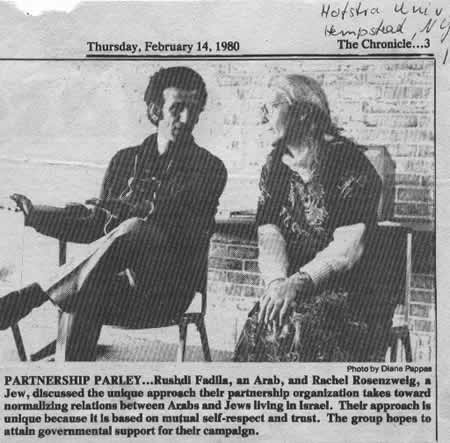 |
"B'nai B'rith Hillel Foundation/ Rabbi Bonnie Steinberg
Febr. 15, 1980 "Dear Rachel, Again I want to stress how overwhelmed and
happy we were with your presentation. We are enclosing copies of the picture
and article which appeared in the Hofstra University newspaper."
To this meeting
20 were invited, 90 came, 30 stood on their legs for
two hours for lack of chairs. The next day Rut Dayan
took me to see "Capitol Hill" , where we
would speak, and for which I had prepared, what may
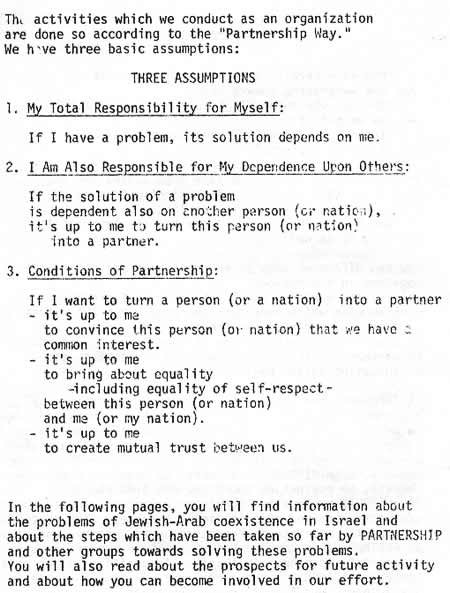
serve as a glimpse into the "Presentation",
which will follow further down.
|
From the beginning I was in close
contact with the widow of Moshe Dayan,
ever since I sought her out, - like a few other "pioneers
for peace", early in 1975,
because she headed a group called "the sons of Sem"
(i.e. Jews&Palestines),
and brought me straight to a new women's group, "GESHER"
(bridge)
founded by Ruth Lis, whose soldier son was killed in the 1973
war.
What was really important in Rut Dayan's work, is not reported
anywhere,
her day to day care for uncountable Arabs and Sephardic-Jewish
citizens.
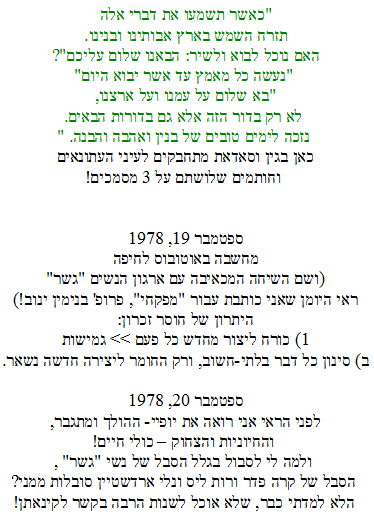
Notes : Preparing
for "Capitol Hill" - Washington, in the home of
Rut Dayan
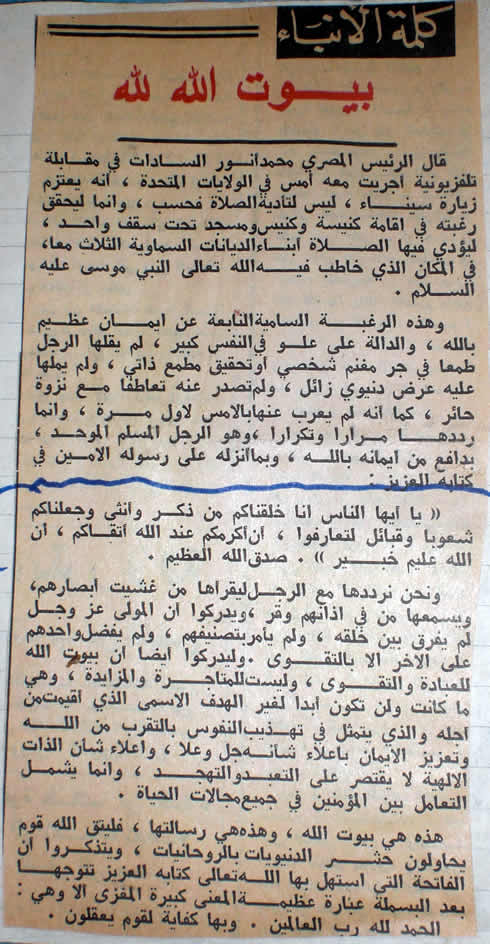
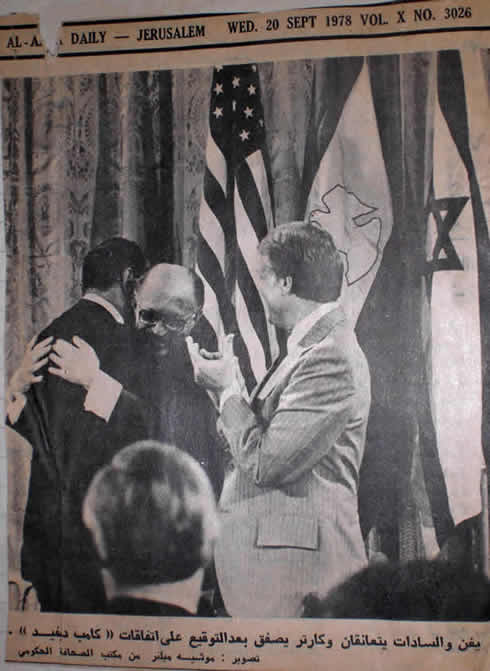
Sadaat and Begin
, though they did not yet set "a relationship of partnership"
as a goal of policy,
demonstrated two important principles of P. (or confirmed
two of our assumptions):
once Begin gave credit - trusted -
to the r a t i o n a l o p e n i n g in
the enemy's statements,
so many things changed.
Suddeny all the irrational actions, statements and attitudes
of the past
had no bearings any more.
Sadaat proved, that
by his initiative
(and it was the "defeated" who started, not the
"victor",
which proves again, that in this area and in this time there
are no victors,
there are only defeated parties)
he could - overnight - humanize the image of the Egyptian
Arab
in the eyes and the hearts of the Jews.
If overnight 30 million devils can be perceived as human beings
who act according to the same laws of human nature
according to which the Jews act,
certainly the devils of the Israeli government or the devils
of the PLO
can be perceived as human beings
who act according to the same laws.
(to add to "Listening")
: to be rational means
to perceive the reality of what I am
and of what the enemy or the adversary is:
that my interest is not to prove that I am right,
but to solve my problem,
and that the enemy or adversary is not a devil -
with whom I, of course, cannot fight,
but a person or persons
who act According to the same laws of human nature as I do,
and who can therefore be won over as partners,
if I only invest enough effort and sophistication in proving
to him,
like Sadaat did with Israel,
that we have the same interest,
in helping Israel to trust him,
that he really believed this and in demonstrating by this
very act,
that there is indeed equality of self-respect.
To end:
To make this offensive work -
to stress again two principles;
the static thinking,
which discusses geopolitical objectives like borders and territories,
has been proved to be ineffective,
since neither nation has so far been able to accept responsibility
for the fact,
that in order to carry out its dream
it has to convince the other nation that this dream serves
their interest.
Also: once the goal
of policy is set
- the strategies and the geo-political solutions will follow
out of it organically.
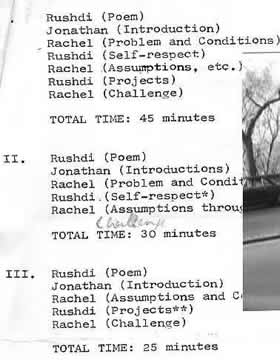
On
our last day , 1980_02_21 ,
I made notes about how we had become used
to present our cause to groups, media and V.I.Ps
Rushdi:
His poem in Arabic and English about
the two peoples which were destined for leadership of humankind,
but are "blind" to each other,
Jonathan:
Introduced himself, "Partnership",
Rachel and Rushdi,
gave some back-ground about the sufferings of both the Jews
and the Palestinians,
adding some details about the Palestinians inside Israel
(policy of "the Arabs - a fifth column" until 1964,
and until today "a stranger in their own land".)
Parable: A man works on the fifth floor and a fire breaks
out.There is no other way out than jumping out of the window,
so he jumps, and falls right on top of a passer-by.
Now this one shouts:
" Why did you jump on me, you had n o r i
g ht to do that",
while the other man shouts back:
"of course I had a right to do that, don't you see, I
had no choice?"
And so
they argue about who was right and who was rong instead of
coping with the situation in which they both are in now.
Rachel:
The question is,
what stops people from coping with their problem,
what stops them from seeing their real self-interest
and from seeing their strength to achieve it?
What is
involved, are f e e l i n g s
, and we have to finally deal with them.
(Another
question is, what stops US, who DO cope, from being effective?
The answer is: we would be more effective, all of us, citizens,
organisations and institutions, political or non-political,
who work for "peace", if we would come to an agreement
about at least three things:
- to propose an overall goal of policy
- to deal effectively with our internal adversaries, not antagonizing
them
- to get
support for ourselves, dealing with our own feelings, in order
to neither get worn down nor radiate anger)
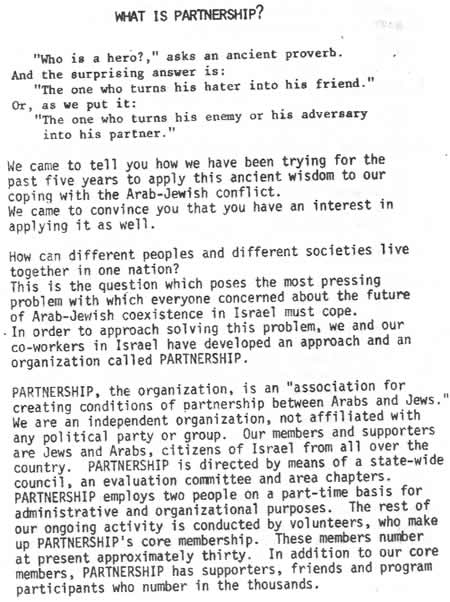
We came
here - not to discuss another geo-political solution - but
rather to point out a new choice for a goal of policy and
a new choice for a way of reaching this goal, and all this
based on the thinking and acting of the last five years.
((I came to the conclusion,
that in future the f i r s t step of developing the theory
has to be - to make people understand, that "to be masters
of their destiny, to be free" - means to take responsibility
for being dependent on others.". Only after they have
internalized this consequence of the only value that I never
found questioned by anybody whom I met so far - f
r e e d o m or self-determination - can they
go on seeing more choices for coping with the conflict. But
below I quote the presentation that we used so far:))
A. A new Choice of
a Goal of Policy:
1) Redefinition
of problem
2) Three options to solve it, that did not work
3) Best
option for a relationship between any two people as well as
between these two peoples: being equal, partners.
4) The
static concept of "peace" (illusions)
versus the dynamic concept of a "r e l a
t i o n s h i p ", like marriage, like partnership
5) The
c o n d i t i o n s for bringing this relationship about
and then fostering it.
the 3 conditions.
(to emphasize, that "anybody who sees h i s o
w n self-interest in removing this threat from the world"
would h e l p - not blame, nor presssure, nor force - those
two peoples to see their common interest and to create trust
between each other in attitudes, words and actions, instead
of supporting one side against the other.)
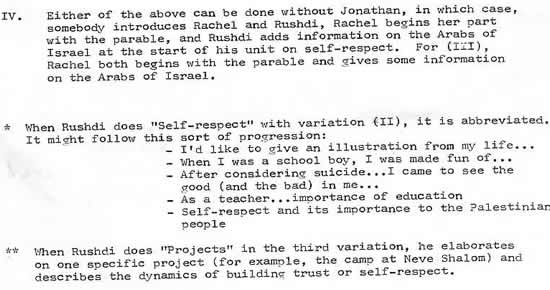
Rushdi:
(Following the explanation of "equality
of self-respect" - as based on the fact, that everybody
is unique and limited - Rushdi demonstrated this first - by
pointing out to Rachel and himself:
because he is limited in English, - knowing his uniqueness
as a teacher of Arabic and Hebrew - Rachel talks about the
c o n c e p t of partnership, while he talks about
the actions, the projects.)
He then
talked about how he applied his personal experience of learning
self-respect ((which he told in detail in earlier presentations))
to the level of his Palestinian nation.
Then he
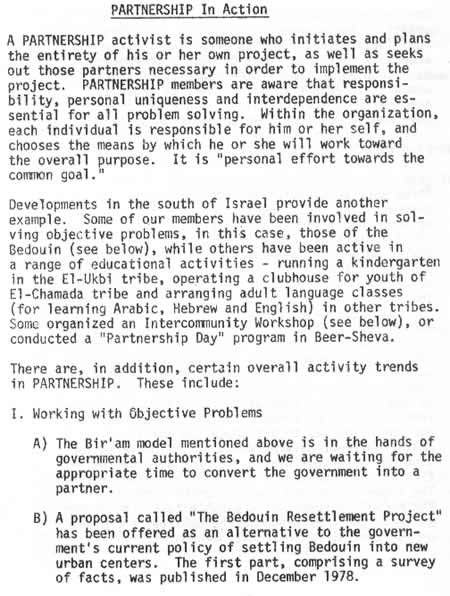
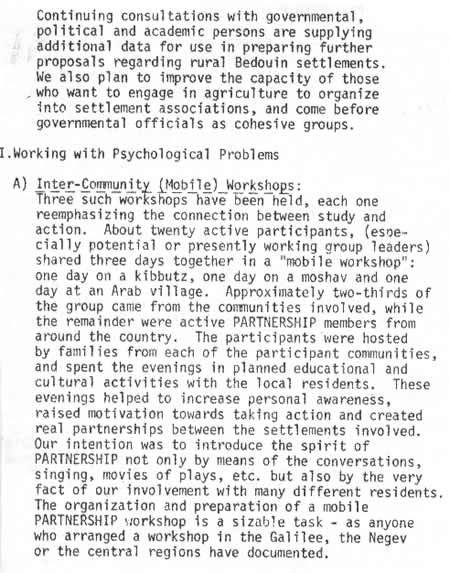
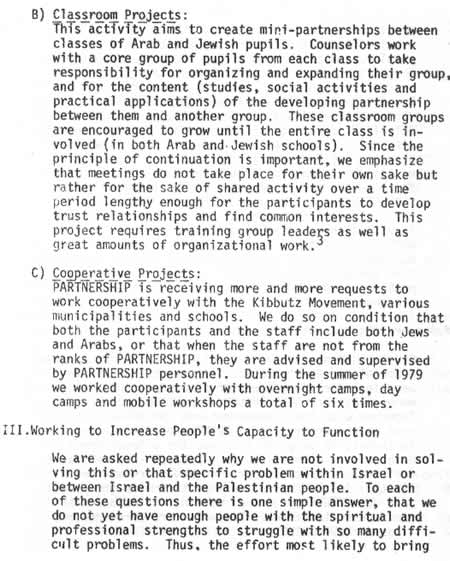
gave details about the mobile workshop with the Kibbutz Movement's
high-school students and the Arab students - in a kibbutz,
a moshav, a city and Neve-Shalom, elaborating on our exercises
to bring about self-respect and the results of this first
step. He then mentioned briefly the Herzliya summer camp and
other activities, exspecially his work in one of the seminaries
where pupils are taught Zionism and where Rushdi is a lecturer.
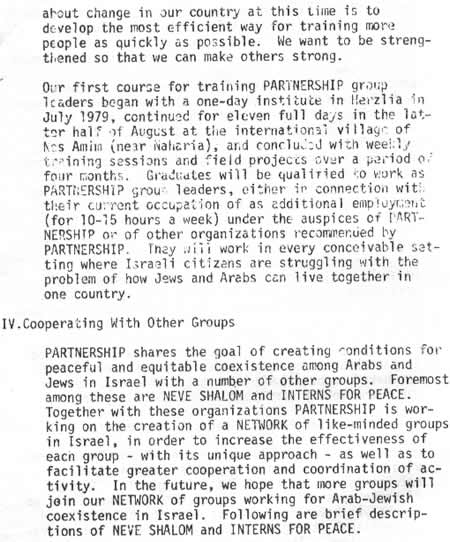
In the end he told about the need of generating facilitators
and counselors, in order to meet all the demands for such
experts, that come to us already from the outside, - our 10
day Course of Jewish and Arab Partnership Facilitators in
Nes-Ammim in August 1979 etc., and he ended up with telling
numbers about the organization.
Rachel:
After
pointing out the difference between the concrete models on
the grassroot-level
and th e s c o p e of Partnership,
I returned to the concept and repeated the "goal of policy"
and the conditions.
So far we talked about , w h a t has
to be done in general.
B. Now we need to
ask, w h o has to do it.
The audience opened page 4 of the pamphlet,
that was distributed:
"Check
for yourself, if you agree with us on the first two assumptions
of P-approach, because this will be the basis of working together.
Pointing
out the first and second assumption,
"Now - what do I do with all these people on whom I am
dependent?
Here comes in a new choice of a way.
Example of how so often, let's say, a Jew could talk to an
Arab, but not to his internal adversary.
Then formulatiing the P-way with concern to all adversaries
and friends, citizens, governments and nations on whom we
are dependent.
C: Having pointed
into a new direction of coping -
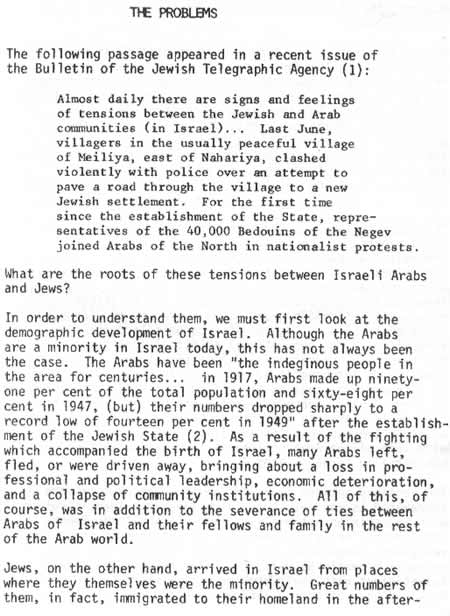
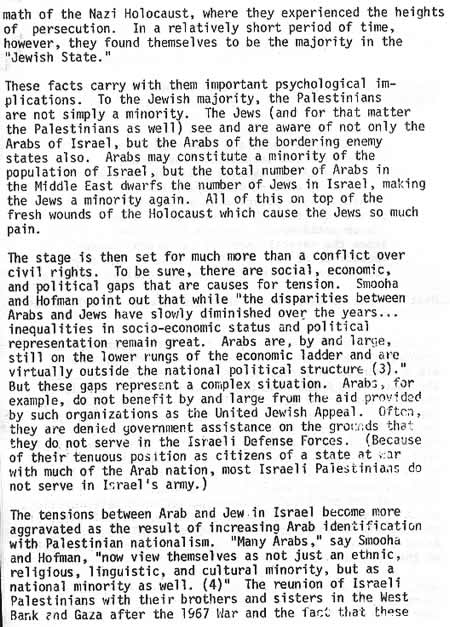
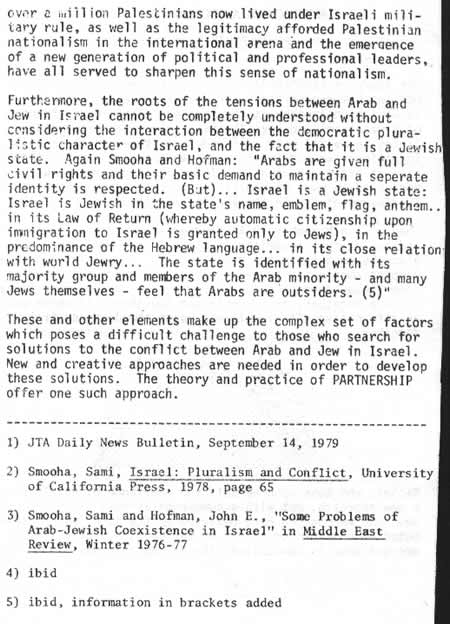
we can have a closer look at the problems
The difference
betweeen objective problems and psychological barriers.
1. An
example for "objective problems": conflicts of interests
over land, in general between Palestinians and Israel, and
in particular, inside Israel.
Pointing to the model of Bir'am.
2) People mostly are unable to cope with the o
b j e c t i v e problems; unless they first cope with
the psychological barriers.
I
mention three:
fear
(the emotional phonographic record on
the Jewish side:
" Palestinian>PLO>terrorists>holocaust>2000
years of persecution."
"and everybody goes numb,
nobody can think about his own interest,
leave alone see the strength in himself to reach it)
humiliation
(record on the Pal. Side:
" Zionists>British>Turks> 400 years of oppression
and humiliation"
powerlessness
= the biggest enemy of both
(we Jews.., we Palestinians, ... we citizens versus government)
If
we want to help people cope with the objective problems, we
have to help them first, differentiate between their feelings
and their ability, to n o t a
c t on these feelings, but rather see their own self-interest,
see also, that the other person (or nation or government)
is not a devil (with whom I, of course, cannot cope) but a
human being that acts According to the same laws as as I do,
((these are
three aspects of "reality",
and seeing reality in this way we defined as "rationality".
I never explained, what I mean be "laws of human nature",
so I'll mention just one:
" everybody needs to respect himself and be respected by others.))
to give
the audience a glimpse of h o w we
overcome psychological barriers,
- I taught them as "a first step"
(in addition to what Rushdi said about self-respect):
L i s t e n i n g (knowing
that what comes up very often in the other person's objections
and antogonizing attitude are feelings, and with those it's
no use to argue
3 gains by
listening:
- having
expressed some of the hurts and fears and feelings of powerlessness,
the other person is more able to see "reality"
(as defined above)
- by listening
I gain trust
- by listening
I gather information -
a) about
the irrationality of the person (citizen, minister, government
or representatives of a nation), where
he is most hurt and I'll not deal with this in the beginning.
b) about
"the rationial o p e n i ng ", the breach
in the wall, where he believes something has
to be done and can be done or even he could do it and then
concentrate on that.
(example
on the top-political level:
Begin who gave credit to the rational
opening of Sadaat's "I want to come".
Example for how people can perceive the enemy as human beings;
Saddat could humanize the image of the E g y p ti a n Arab
in the eyes of the Jews over night)
(Sometimes
I added:
to be able to listen,
I first have to be listened to,
I have to deal with my own feelings, time and again,
this is the third most important criterion for effectiveness,
that all those people who already c o p e ,
take responsibility for getting emotional support,
so as not to get worn out and not to radiate anager,
but being able to help others with t h e i r feelings)
The question
is again not only, with w h a t problems
do we have to cope, but
(3) w
h o is going to cope
Then pointing
out the "crux of efficiency and effectiveness:
training people, who would then be able to help others to
cope with the objective and the psychological barriers.
-to help
them talke responsibility for being dependent on others,
- to help
them see more choices
-to help
them aquire tools for dealing with feelings and then tools
for coping with objective problems ((like coming up with solutions
for conflicts of interests over land, in a way that the interests
of the Arabs are being met and the interests of the Jews not
being harmed, so as not to reverse the problem)
To give
them a glimpse of what's involved;
a pilot in the Israeli army has to learn
and practice for 6000 hours, 10 hours a day for 2 years..
the same effort, time, money, skills are needed to train the
people, who would help others to cope in the way outlined
above)
D. The purpose
of our tour: to start an over-all offensive:
Our models
- like a scientist wants to prove a theory, that it can be
done.
No illusions, that by just building the i n f
r a - s t ru c t ur e towards this goal of "a
relationship of partnership" would win the race against
time.
On
this tour - we not only l i v e partnership,
but confront people with our thinking, so as to include in
an overall offensive
- everybody who already sees his o w n self-interest
in removing this threat from the world,
((to point out, that one does not have
to be a Jew or an Arab to see one's self-interest))
or a challenge
to his o w n creative powers, to work
for solving this conflict
Again
a military example: to win a war -
not just one tank~~~ not just on one front~~~always alternative
plans in the drawyer, always people in charge who are used
to think creatively.
To exemplify,
what we mean by "offensive",
I made a movement with my two arms, one pointing to "building
the infrastructure from the bottom", the other pointing
"to work from the top",
so as to h e l p (not force, pressure
or blame), the leaders of Israel, the Pal., the US and maybe
of Egypt as a mediator:
- to face
the fact that each one - in order to carry out his own dream
- is dependent on the other nation, and
then accept responsibility for proving to the other that my
dream serves his interest too.
- to see
more choices than just reacting emotionally, as most governments
and nations do today (also with regard to problems
like Iran and Afghanistan)
-
to rediscover the strength in viewing
the achievement of a relationship of
partnership as a goal of policy and
then to r e a c h this goal.
Sometimes I
pointed out 3 targets of this offensive;
-generating
- by training - as many people as possible who then would
be able to cope and help others to cope...
- the ideas of the WELLS
[everyone has not only problems in his life, but the strength
in his being,
to turn problems into challenges, like there is ground water
even in the desert, but each one has to dig a well to his
own ground water]
- turning
into partners all those people, politicians and non-politicians
who already sow the seeds, which will make the desert bloom,
once the rain comes, and to help all of us to become more
efficient and effective, According to the 3 criteria mentioned
in the beginning.
- building
a strategy - according to the --approach - to reach the leaders,
((two criteria for setting priorities:
-to check,
on w h o m I am most dependent, in order to solve
my problem?
- who
among those, on whom I am most dependent, are the most "rational"
people (as defined above).
Example:
everybody is a potential partner, but some people are more
rational then others, let's say in the Israeli government
or in the PLO ((in case the PLO should be the potential partner
on whom Israel is m o s t dependent)). I will
then work with these people, and they will either be able
to win over the more irrational leaders, or at least manipulate
them into a direction which serves the interest of all.
By telling
people, what to do, it is very important to make them understand,
that all our suggestions are just ideas to help their own
vision. What's important is, to make them see the importance
of a s u p p o r t i ve f r a me -
w o r k , so as to guarantee co-ooperation a n
d continuity:
A new
format of a workshop:
a) goal:
to work out concrete steps, and strategies
- like
what do we, as a group, want to do
- or developing
a proposal for solving one of the objective problems
- or finding
out, what any individual would like to do According to his
own skills and creative power, so as to
guarantee that everybody relates to his work as a painter
towards his painting, not doing a favor to the world, but
creating something meaningful.
b)
Process:
to internalize the approach - how to
accept responsibility,
how to see the infinite choices and how to choose the best
in any given situation.
c) Leaning; how to deal
with feelings, my own and those of others.
One last
thing; whenever the static thinking of people: bi-national,
secular, etc. comes in the way:
To state dynamic thinking, process, creating conditions for
a much more optimal solution than any of us can envision today
- versus discussing objectives~~~
End
Like
my partner started his poem in Arabic, I want to end in Hebrew.
What we say is not new, it's the message
of double responsibility,
phrased 2000 years ago by the Jewish sage Hillel:
"If
I am not for myself - who will be for me,
but if I"m only for myself - what am I?"
- if I don't take responsibility for
being dependent on others and then turn this dependency from
something that harms me into something that benefits me -
what have I done for M y s e l f ?
"and
if not n o w, w
h en?"
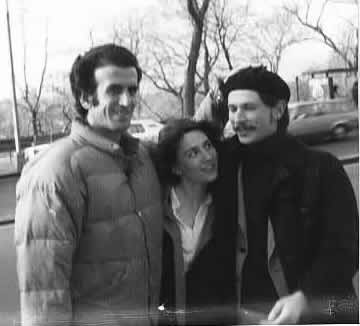
Jonathan was often with his girlfriend
Laurie
which meant additional help and additional need to work on
emotions.
Jonathan
asked for relevant comments and questions,
the presentation never took longer than 30-35 minutes,
the second part took from 10 to 120 minutes, differing from
audience to audience. In most cases this part meant for us
to deal with feelings
and demonstrate our approach by "handling" the audience
in a way that people could really listen and learn.
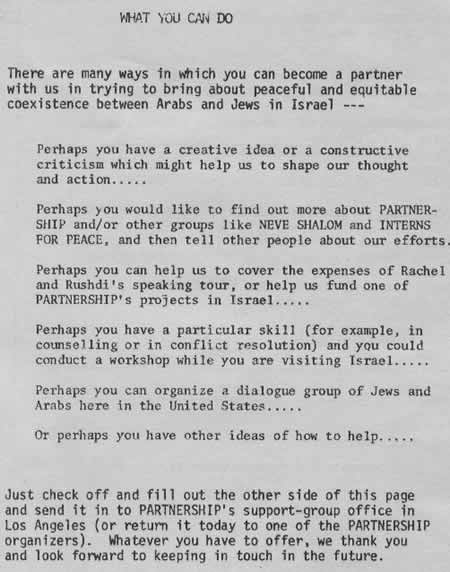
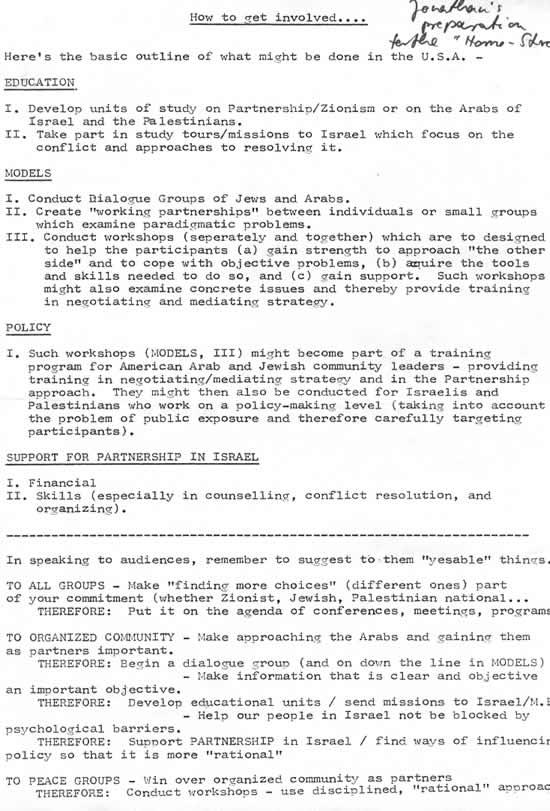
We always ended in pointing out what people could d o ,
to become involved in this offensive.