| The
Purpose of HEALING - K.I.S.S.
- as stated 12 years ago - was and is
to help me and my potential P E E R s
"to HEAL ourselves into WHOLEness,
and - by extension - all of CREATion!" |
|
I focus my experiencing and awareness on being
"a pioneer of Evolution
in learning to feel":
I let my Body vibrate and my Heart 'womb'
pain, shame, fear, boredom, powerlessness,
so feelings can >heal >guide>fulfill>evolve,
and ~~~ offer ~~~"goldmines"~~~ to us all!!
"I
want you to feel everything, every little thing!"
|
|
Re-edited
on July 24, 2013 ----------- In
this research - first completed 41 years ago -
I cannot update, how the central concept of "SIN"
has to be radically transmuted.
Sin is "Suende" in German, which derives from "sondern"=
to separate.
The actual "Suende" is "Denial", i.e. the separation between
Thinking and Feeling,
i.e. the lack of awareness - by ignoring, overriding, repressing -
of what I do not want in my life - a) feelings, b) needs, c) qualities, d)
greatness.
These denied parts of myself do not simply disappear ,
but survive in body and soul and all around me,
they even attract more of the same denials, become monstrous,
produce evil doing, perpetration, or evil suffering, victimhood.
The redemption from "Sin", i.e. from denial and "Lost Will"-
and from there the redemption from suffering and death,
begins with learning to feel, i.e. to accept, "to womb" what I feel,
to move it physically and then to understand...
In other words: I can allow myself to feel unpleasant feelings, needs, qualities,
only if I KNOW and PRACTISE - that every feeling, from the tiniest to the
biggest -
must be V I B R A T E D , i.e. physically breathed, sounded,
moved,
in order to heal and evolve, and then fulfill its task: to guide me and to
full-fill me.
Once there was a quantum-leap in evolution,
when humans understood that there was a connection between suffering and doing.
Since they knew from the beginning (unlike humankind today), that the many
and the one were tied together,
their "solution" then was, to uproot the one evil-doer from the
community, so as to spare it the consequences.
The next quantum-leap in evolution, was,
when it was understood that this "solution" caused even more suffering,
and they evolved the idea of "reproach and protest".
This, also, caused more damage than benefit.
The "solution" people then came up with, was not an evolution,
but a re-volution, a re-gression:
it was to deny the connection between doing and suffering altogether
and to ignore the mutual guarantorship between the one and the many.
As the present time-period shows, this was/is a horrendous denial,
yes the culmination of an absurd, monstrous illusion.
Now the time has come, to go down to the deepest roots of both:
the connection between doing/notdoing (=denial) and suffering,
and the connection between me, the individual, and everybody else .
July 31, 2013
The root is the disconnection between the aspects of "God" or humans:
Spirit-Will-Body --or thinking-feeling-sensing...
When Spirit/Mind denies feelings or needs or qualities and greatness,
then these feelings, needs, qualities and greatness become "Lost Will".
Lost Will either undermines myself and - as its worst - causes "cancer",
or attaches itself to other people who are weak in their self-acceptance,
who then - in order "to do" something - produce havoc all around
them.
 |
My PH.D.-Thesis, 1966-1982, University 1972
Original Theme,1966 : The Idea of VICARIOUS
SUFFERING as an ANSWER to INNOCENT SUFFERING
(i.e. my coping with the holocaust).
Final Hebrew Title 1972: "The PERCEPTION
of SUFFERING and SOLIDARITY
with the SUFFERERS
in the Thought of the Jewish Sages from the time of the second Commonwealth
till the End of the Talmudic Era"
(i.e. in Bible, Apocryphes, Qumran, New Testament, Talmud, Midrash)
|
|
See
the overview of "MY BOOK" in the context of "MY LIFE's
HARVEST"
 |
"All
Israel are Guarantors for Each Other"
Maryam, alias Christa-Rachel Bat-Adam,
married Rachel Rosenzweig, born Eva-Maria-Christa Guth
|
|
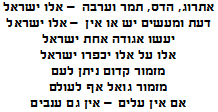
| Etrog,
Myrtle, Date, and Willow
-- these are Israel!
Knowing and doing do exist or do not
-- these are Israel!
They shall make one union - Israel!
They will atone for each other -Israel!
An ancient psalm was given to the nation!
A redeeming psalm also for the World!
Without leaves- there won't be grapes!
|
|
|
|
English Summary and Digests
continuation
of Rafael Rosenzweig's translation of the original summary
of the PH.D. thesis delivered to the Jerusalem University on Purim 1972
DIGEST - SECOND PART,
SOLIDARITY WITH THE SUFFERER, Chapters 6 and 7
II.6 Lack of Solidarity of the
Dead Sea Sect
II.7. Jesus' solidarity with the
sinners and the sufferers
and the solidarity with
the crucified Son of God
as the focal point of the messianic movement.
II.6
Lack of Solidarity of the Dead Sea Sect
The spiritual origin of the sect:
the apocalyptic individualism
Segregation from the "men of evil"
Accentuation of the segregation through the ideology or predestination
Aggressive dreams
Lack of solidarity in the society of the sect itself.
Like any other philosophical
or real situation,
the consciousness of solidarity and of mutual guarantorship stands out on the
background of its opposite.
Irresponsible privacy and anti-solidary isolation were both common occurances
in Israel's history as well.
I have refrained from using the usual, well known examples of anti-solidarity
committed by single Jews,
who went all out for their private security,
like Josephus Flavius,
or like the party of the Extremists,
who were mad for private power, murdered their fellow Jews and destroyed their
community.
The example of the Sect in the Desert lights a warning signal to all generations,
because these auto-segregators from the community
did want to realize the aims of the chosen people
and were, indeed, conscious of the sins of their community
and aware of the suffering which was to be expected.
Unlike Israel's emissaries, however,
they did not identify with their community in order to reprove it and to prevent
its suffering.
To the contrary - they put a dividing wall between themselves and "the
men of evil", Israel,
in order not to be swept away together with them into the apocalyptical calamity.
The lack of solidarity
not only expressed itself in geographical and social isolation,
but also in a sophisticated ideology.
The men of the "Yakhad",
i.e. "togetherness", emphasized
that their own sins were not less than those of others.
In order to justify, in spite of this, their segreation from "the
man of evil",
they invented the intellectual gimmick of "God's
predestination".
This gimmick poisoned all the opinions of the sects;
their God appears as a monstrous and arbitrary tyrant.
He does not identify with his creatures in their suffering and in their sinning
-
he has created evil people to begin with,
in order to prepare them for slaughter
and thus relish in his power.
Parallel to this description of God is the Sect's character.
The men of togetherness were conscious of their uniqueness,
but this uniqueness was not a function of their solidarity,
[as in the thinking and living of the Jewish
sages]
it did not require the responsibility of making evil
men turn to the path of righteousnes
and to save their community from suffering.
To the contrary:
their uniqueness required, as they themselves saw it,
to become, in the near future, a tool for the destruction of the evil.
However - the segregationists perished and Israel continues to exist.
A further warning was contained in the fact,
that the lack of solidarity was part and parcel of the very organization of
the sect.
The communality of all belongings and the required brotherhood
were the mask of a tyrannical collectivism, pityless toward the erring individual
and of a hierarchy which did neither allow for any kind of equal rights of men,
nor for the uniqueness of the individual.
[I was harshly critisized
for this harsh judgment on the people of Qumran,
who are identified with the "Essenes", who, in turn, have become very
popular among New Age people.
I still can't understand, how anyone can analyze their scriptures, rediscovered
in 1947 or 1948,
and not share my judgment.
From a higher level, of course, there is nothing to be judged.
These people made a learning experiment, like the rest of us,
and -"in the end" - we, the waves of the One Ocean, shall all benefit
from that experiment]
II.7.
Jesus' solidarity with the sinners and the sufferers
and the solidarity with
the crucified Son of God
as the focal point of the messianic movement.
The essential difference
between the Messianists and the Dead Sea Sect
Jesus identifying with the sinners
The element of solidarity in the Christian ideology
The belief in the solidarity of the Son of God as the foundation for "admonition"
and for "consolation".
As much as there was a similarity between the Messianists
and the Dead Sea Sect
in their ideas regarding eschatology, dualism, and, to a certain extent, their
determinism
there was a huge discrepancy in their actual approach to people.
Jesus of Nazareth's aim was not to isolate himself and his followers
from the sinners and the underprivilegded
("since they, as well, are the children of Abraham!")
but to bring them closer to the people and to rescue
them from their sins.
The extreme demonstration of his identification with the lowliest of the low
in Israel
caused the spiritual leaders to stand up against him,
but the very same demonstration also prepared the ground for "reproof"
and "return"
and it redeemed "the erring sheep of Israel".
This was the singular
characteristic of Jesus,
and Paulus recognized
it.
When he included in "the erring sheep"
also the other nations,
he went farther than his master,
but the application of the solidarity between all people was only a logical
consequence.
With the acceptance of solidarity with the sinners and the nations of the earth,
Jesus and Paulus put the imprint of Judaism on Christianity,
even if this imprint was covered for many generations under heaps of
irrelevant dogmas, heathen forms and murderous enmity towards Jews and Heretics.
Jesus' solidarity did not only cause Paulus'
activity amongst the nations,
but also played a part in the conceptualization of the central Christian belief.
An outstanding example
for this is given by the author of the "Epistle
to the Hebrews",
who had an excellent Jewish and Greek education, compared to other authors of
the New Testament.
How did he succeed in planting the heathen conception of "God's Son"
into Judaism?
As far as he was concerned,
God's son had to identify himself with all men
in the totality of their mental and physical suffering.
Only because he himself felt "temptation",
was he able to succour those who suffer from
"temptation".
It follows, that the aim of God's being human, human
unto death,
was not to prepare Man for the coming world by pacifying God's wrath,
but to prepare Man to measure up to life in this world,
to measure up to his sinning and his suffering.
In other words, the belief in the solidarity of God's son
supplied a new and important base for "reproof" and "consolation",
and especially for consolation:
as God's son identified with Man in his suffering,
thus Man, in the hour of suffering, may identify with God's son.
I suppose [I know from myself]
that suffering people's identification with this crucified
Messiah
brought unmeasurable consolation to a very large number of people.
The principle of solidarity - in the form
of the God-Son's identification with the sinner
and that of the sufferer with the crucified God-Son
was, therefore, the base of the daughter religion of Judaism.
But there exists a vital difference between this base and the philosophy of
solidarity of the sages.
The principle of solidarity was narrowed down and focused in Christian belief
on one man only,
the messiah.
Furthermore, the principle was removed from its rational and secular context
and embedded in a metaphysical and apocalyptic ideology.
However, a solidarity which is not rooted
in the Law of Mutual Dependence and Mutual Guarantorship of a l l men,
will not be capable of evolving
the uniqueness of the individual
and his responsibilty towards the community.
There is a precarious
balance between "reproof" and "consolation".
Man needs both - one as a need to change his fate,
and the other as a need to make his peace with it.
Christian religion disturbed the balance and emphasized "consolation".
This emphasis is understandable in an apocalyptic atmosphere,
when every individual lives for the short range only.
But in the real world, which requires the shaping of destiny in the long range,
the neglect of "reproof" is a dangerous one.
It is for this reason, that the thinkers of modern Christianity
have based the demand for responsible action on the secular law of solidarity,
the very same law which so deeply concerned the moral philosophers from amongst
the sages of Israel.