I focus my experiencing and awareness on being
"a pioneer of Evolution
in learning to feel":
I let my Body vibrate and my Heart 'womb'
pain, shame, fear, boredom, powerlessness,
so feelings can >heal >guide>fulfill>evolve,
and ~~~ offer ~~~"goldmines"~~~ to us all!!
"I
want you to feel everything, every little thing!"
INTRODUCTIVE DIARY 2002/2013
re-edited between July 13 and September
16, 2013 -
with an addition about my present thinking/feeling/living ,
sculpted during the weeks before my 75th birthday on August 15, 2013 "I am a
pioneer of Evolution in learning - to - feel
!!!"
My PH.D.-Thesis, 1966-1982, delivered
in Hebrew to the Jerusalem University 1972 Original Theme,1966 : The Concept of
VICARIOUS SUFFERING as an ANSWER to INNOCENT SUFFERING
(i.e. my coping with the holocaust).
Final Hebrew Title 1972: "The PERCEPTION
of SUFFERING and SOLIDARITY
with the SUFFERERS
in the Thought of the Jewish Sages from the time of the second Commonwealth
till the End of the Talmudic Era"
(i.e. in Bible, Apocryphes, Qumran, New Testament, Talmud, Midrash)
Title
of the German Book1978
(Rachel Rosenzweig) Solidaritaet mit den Leidenden im Judentum "Solidarity with the Sufferers
in Judaism"
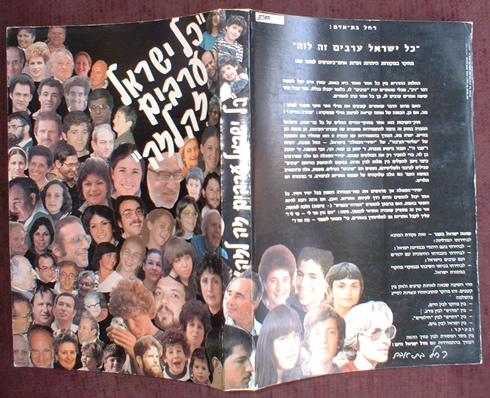
Title of
the Hebrew Book1982 (Rachel
Bat-Adam) "kol yisrael 'arevim zeh la-zeh"
"All Israel are guarantors for each other"
"All
Israel are Guarantors for Each Other" Maryam, alias Christa-Rachel Bat-Adam,
married Rachel Rosenzweig, born Eva-Maria-Christa Guth
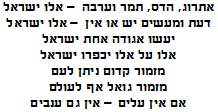
Etrog,
Myrtle, Date, and Willow
-- these are Israel!
Knowing and doing do exist or do not
-- these are Israel!
They shall make one union - Israel!
They will atone for each other -Israel!
An ancient psalm was given to the nation!
A redeeming psalm also for the World!
Without leaves- there won't be grapes!
The Cross: my old belief in struggling!
The Etrog: my rejoicing in fulfillment!
Scanned Pages
of the German Book and the Hebrew Book
I
marked names and quotations to convey the
message: "Whoever says something
in the name of the person who said it,
brings redemption to the world"[Avot
6,6 & Siddur]
red:
Hebrew Bible and New Testament
orange-filled:
Qumran, Apocrypha, Talmud&Midrash
green: other names, mainly of modern researchers
On this website each
"bundle" [of pages in the paper-books]
begins with the overview of all parts of the books.
Titles in blue refer
to the content on the page you open. Titles in grey
refer to the rest of the books' titles.
INTRODUCTIVE DIARY 2002/2013 2002_09_17, a day after Yom-Kippur,
3 days before Succot ; last updates: 2009_07_11;
2013-07-13--08-14
After the exit
of Yom-Kippur I saw a German documentary: "Hunting Scenes from South Spain"!
about a "Crystal-Night", a raid by the masses against "Moros",
guestworkers from Marokko and Algeria,
in the Spanish province Almeria around the town Aljido, in February 2000, with
the police standing idly by. "One man has killed a woman out of jealousy,
and many thousands of his kind are persecuted on his behalf."
This phenomenon among human beings
expressed in that ancient Jewish proverb is the title of my book:
"All Israel are guarantors for each other",
i.e. - are held responsible for each other.
My research shows,
how victimhood (I'm held responsible) is transformed
into mastership (I am responsible, I take responsibility).
When I walked down my path, back from
my collapsed figtree, the next morning,
I had another breakthrough or "break-back". "Start scanning both editions of your
main book, the Hebrew and the German one,
without worrying about an English translation!"
It's time to integrate my full identity, which is German and Jewish/Israeli,
and my own languages, which are German and Hebrew
indicated in the names "Eva Maria Christa Guth" and "Rachel Rosenzweig"
with a seemingly additional identity, which I adopted for
"God is Evolving",
the identity of Maryam, who writes in English.
"Seemingly" - for my twofold nationality and my universality are already
One
in the surname I chose in 1981: "Bat-Adam",
"Daughter of Hu/Man".
SEARCH for EXACT TERMS in ENGLISH
May I, the foreigner to the English language,
be forgiven for inventing some new words
in order to convey the message expressed in the main Hebrew terms:
like "mastership"
[ribbonut], the contrary
of "victimhood" [qorbanut],
The main problem is with the translation of the noun 'arevim
in the ancient proverb, which is the title of the Hebrew book.
When my husband translated the summary of
my thesis in 1972,
he finally came up with a certain term, which - as I see today - is no equivalent
at all.
With "Roget's Thesaurus" and "Babylon"
- English-Hebrew, German-English - at hand today,
I now - 2002_09_19
- decided to translate'arev
as "being a guarantor"
and 'arevut
as "guarantorship",
and not to use verbs like: "to vouch for",
or "to pledge", or nouns like: "warranty" or "surety"
because I cannot derive from them "vouchers" or "pledgers".
The verb "to guarantee" on the other hand has too many additional
meanings to be an equivalent.
For the word in Hebrew can have an intransitive, even passive meaning: "I am a guarantor,
i.e. I am held responsible for something that was done by someone else."
or an active meaning: "I am a guarantor,
i.e. I take responsibility for preventing something from being done by someone
else."
I still need to derive a new word: "guarantorship". For the word "suretyship" is too confined
as a legal term.
2002_09_18 ; last update: 2003_06_03
The Source of the Concept of "guarantor"
and "guarantorship":
Juda, Josef and Benjamin
The noun 'arevim
is derived from the verb,
which Juda, one of the 12 sons of Jacob, uses twice in the story of "Joseph
and his brothers".
This story, on which I wrote a paper in
Jerusalem in 1961, always moves me to tears.
Yehuda is to become the one
who will give the Hebrews, the Israelites their later name:
Yehudim,
"Juden" in German.
I believe, there is deep meaning in how this story lets Juda,
who is the fourth son, not the firstborn, evolve into a leader:
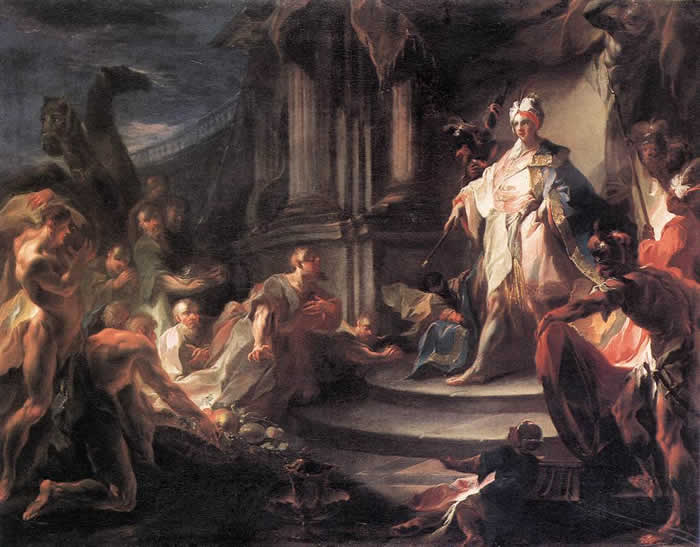
Josef, formerly sold into slavery by the brothers , recognizes them,
when they come to buy grain in Egypt
at a time of famine in their own country, Canaan.
He demands from them to bring their youngest brother with them,
if they ever want to buy food again.
Jacob, who still mourns for his favorite son, assumed to be dead,
refuses to let Benjamin go.
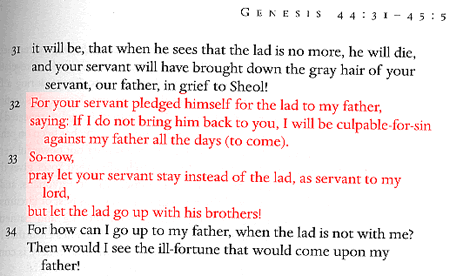
It's then, that Yehuda steps forward and says: "Send the lad with me,
and we will arise and go,
that we may live and not die,
so we, so you, so our little-ones! I will act as his pledge [the whole sentence is one word, ae'aervaennu,
from the root "arav"] at my hand you may seek him!
If I do not bring him back to you
and set him in your presence,
I will be culpable-for-sin against you all the days (to
come). [Genesis
43,9, translation of
Everett Fox, s. "wholeness of the Bible"]
On their way back from Egypt,
Josef sends his servants to catch up with them
and to blame them for having stolen Josef's silver goblet.
The goblet is found in Benjamin's pack
(where Josef had ordered to put it secretly).
This is their test!
Will they betray, abandon, extradite, sell a brother again?
Since I now
possess the
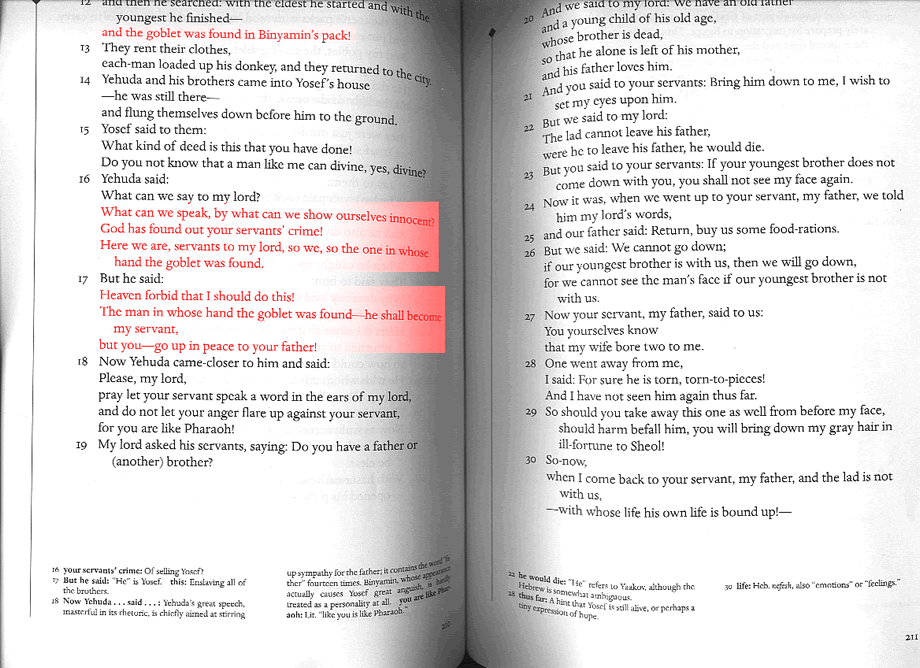
translation of Fox, I'll scan Yehuda's second speech in full, a speech to the powerful Deputy of Pharao, his
disguised brother Josef [Gn
44].
It shows clearly, how Yehuda becomes an 'arev,
a guarantor, in the active sense:
2002_10_05; last update;
2003_06_03
I
marked names and quotations to convey the
message: "Whoever says
something in the name of the person who said it,
brings redemption to the world"[Avot
6,6 & Siddur]
red:
Hebrew Bible and New Testament
orange-filled:
Qumran, Apocrypha,
Talmud and Midrash
green: other names,
mainly of modern researchers
Emphasizing so many individual names
and quoting so many other people
demonstrates the main message of my study:
The Biblical and Talmudic literature is overflooding with personal names
of individuals,
which
contrasts sharply
with the ghastly hierarchical community of
Qumran,
which they called the "Yakhad",
Togetherness,
and which left us not a single personal name
of a "yakhid", "an individual".
The "yekhidim",
the individuals, who composed that community,
may forgive me for judging their hypocrite "Yakhad" so harshly.
Know that I am grateful for the contrast
which your false "Yakhad" provides.,
So far we all learn best by contrasting and polarizing.
Israel's Sages even had an expressive principle for quoting,
expressed both in negative and in positive form:
"Whoever
says something
not in the name of the one who said it,
has killed a soul."
"Whoever
says something
in the name of the person who said it,
brings redemption to the world"
I set out to understand the suffering of innocent
individuals
I soon was led to understand the dependency of the individual on his/her
community.
And I ended up in understanding, how from this dependency follows the individual's
uniqueness.
A Biblical and a Talmudic episode about Moses may
exemplify this:
Moses had liberated the Hebrews from external slavery in Egypt
and led them to the desert to make them grow towards internal freedom. Instead, time and again, (the
Torah mentions 7 times), the slaves wanted
to return to the meat pots in Egypt.
Moses feels unfit and depressed to death,
until God shows him 70 elders to help him carry the burden.
He gathers them around the Tent
of Appointment, so God would take from his spirit and give it unto them.
Two of them, Eldad and Medad, did not come to the Tent, but started to prophesy
outside, in the camp.
Josua, later a leader himself, but then a sheepish assistant, projects on
Moses his own fear for his honor: "My lord Moses, imprison them!" It's then that Moses rises to his full stature
and says: "Is it for my sake, that you are
jealous?
Who'd give, that all HIS people were prophets!" [Numeri 11]
On April 20, 2012, Meirav
Meidan told me the interpretation of Rashi to "imprison them" - "kal'em"
"hatêl alehem tzorkhê ha-tzibbur ve-hem kalim me-atzmam"
"put on them the needs of the public and by themselves they perish"
A Talmudic story depicts another incident of slavish
behavior.
In this case God told depressed Moses,
that he would destroy the people once and for all.
Moses jumps to his feet and defies God himself:
"zae
talui bi"
this depends on ME!"
2002_10_19; last update: 2003_06_03
The immense endeavor to facilitate convenient navigation
concerning the spreading of my books on the Internet
drags me deeper and deeper into that old research.
And often I emerge and glare with new wonder.
Isn't this root 'arav
of the noun 'arev
mystical?
The words 'ivrim', Hebrews
and 'aravim, Arabs,
have the same 3 consonants "ayin,
beth/veth, resh",
in both Semitic languages, Arabic and Hebrew,
except that in 'arav the
latter two are inverted. 'ivrim comes from the word
"to pass", "to move beyond",
and 'aravim from a root,
that has produced many meanings;
among them "evening/west" and "steppe", desert like
land.
For the word to mean guarantor,
it has to be pronounced 'arev
in the singular,
and until now I never doubted that in the plural it must be pronounced
'arevim.
But since books are usually not equipped with the kind of dots that
indicate vocals,
the title of my Hebrew book can be easily read as : "All Israel are Arabs - 'aravim
- to each other".
In fact, some time after the publication
of the Hebrew book,
Khaled, an Arab journalist, called me and asked for a copy.
He said with admiration: "That
you would write such a book!" I sent him to the shop and never heard
a word from him.
It dawned on me then, how he must have read the title.
I ached - imagining his shame and his disappointment.
Now I came across a note in my books
saying,
that, in fact, the correct plural of'arevis'aravim, but the wrong usage - 'arevim
- is too ingrained.
While re-reading pages in my archive,
I came across this passage in my letter,
which I wrote to Abraham Margaliot, the only one who had turned
to me by his own initiative
after my lecture in the Jerusalem University, in March 1973,
about the theme of my thesis.
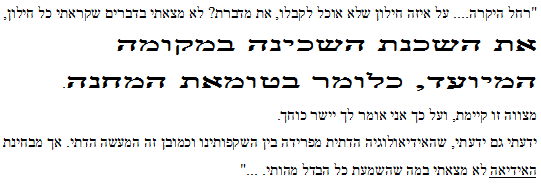
I also discovered a letter from
Prof. Ernst
Akiba Simon,
a pupil of Franz
Rosenzweig and a friend of our family,
in which he wrote: "What secularization, that I wouldn't
be able to accept, are you talking about?
In the words I read[probably
in the "English Summary"],
I couldn't find any such secularization.
You [Rachel]
made dwell (the same root as 'shechina')the Shechina
in her appointed place,
which is in the impurity of the camp [of
the Hebrew slaves during their 40 desert years]!"
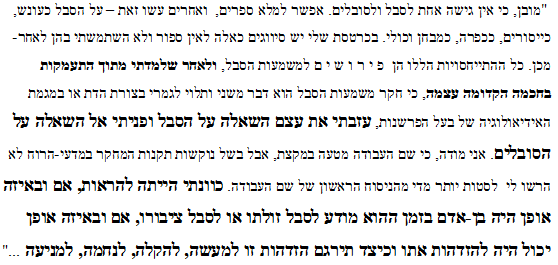
This sentence was first of all
an acknowledgement of my stunning discovery
of God's Solidarity with the Sinner (which is very different
from the Christian ideology about "Atonement",
i.e. God had to send his own son to suffer as an atonement for
our sins)
THIRD
P A R T : In German:
SOLIDARITY and RESPONSIBILITY In Hebrew: REALIZATION
of RESPONSIBILITY
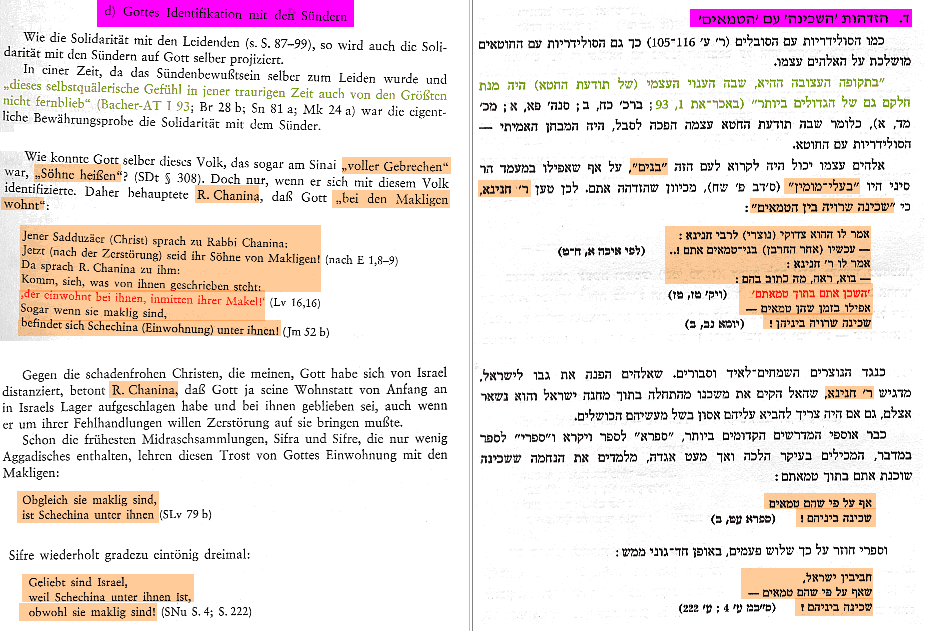
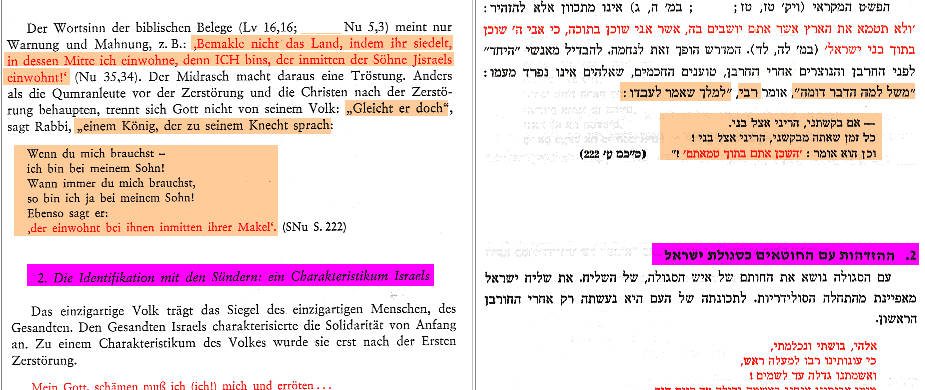
Second Chapter:
The
Identification with the Sinner 1. The identification of the
emissary with the sinning community a)
Moses' solidarity with the sinners
b) HIS Servant
c)
Refusing solidarity with the sinners
d) God's identification with
the sinners
As I read Simon's sentence, written in 1973,
in the year 2009,
"You made dwell the Shechina
in her appointed place,
which is in the impurity of the camp !"
I see better than before,
that the Shechina's solidarity with the sinners,
is a notion which comes close to "Loving Light is truly worthy of the
title 'God.'
It is Light that's willing to somehow find its way ~
to dwell with the Mother and her most painful realities in Hell!" [see Godchannel,
"Awareness" , quoted in puzzle
piece 54: Light's way to dwell in Hell]
except that according to the understanding of that Midrash and
of Simon,
God or I have to descend to the Hell of the people, "the
camp",
while in Godchannel it is the Shechina, The Mother, God's Feeling
aspect, who is herself in Hell.
[See the blessing + my tune - of Uniting
The-Holy-One-Blessed-Be-He with his Shechina
at the bottom of each of the
AUschwitz-BirkenAU pages]
As I now insert that chapter about
the Shechina-in-their-impurity,
though a translation into English is still missing
tears come to my eyes...
From this day, July 11, 2013 onward
- - - - till August 27
- before and after my 75th birthday on August 15, 2013
I was being jolted into re-understanding my vocation:
All my former goals since the ages of 7, 13, 27, 50, 67,
were meant to create training-grounds for becoming:
a pioneer of Evolution
in learning-how-to-feel.
It is fitting, that I could squirm
myself towards this understanding not in a linear way.
And so now - on Yom-Kippur 2013 - on
the 17th FELT day of the next 15 FELT years,
I want to collect, harvest and savor the fruits as they ripened
- as - insights-in-stages,
just like the fruits of my pomegranate-tree have been ripening since
July 11 till now! [2013-10-05- Today I peeled
the last pomegranate- and ate/drank it (from the blender! because
of my temporary dentures).
Since July 11 , I ate one fruit every day - many of them were not
"whole", of course - but also Ofir's friend picked about
20 fruits
and when Tamir's family visited and little Re'i was so enthusiastic
about eating fruits from the tree, we picked another 20
]
This spring-flower
(kova'
nazir/monk's
cress) photographed by me in 2003, decided to blossom
(in a planter) now, in Arad, in August-Sept. 2013!!!
July 16-August 15, 2013 [my 75th birthday]:
My endeavor to once again re-phrase my vocation
inspired by experiences and by re-studying my book "kol Yisrael arevim zae la-zae"
My progression from
the term "vicariousness" to the term "pioneership":
I am a pioneer of Evolution in learning how to feel The thinking-feeling here has to be complemented
by the parallel thinking-feeling in "Waking
the Tiger"
[I've re-written these passages
so often, that I forgot when I first phrased them,]
The decision to add the numbers
of the pages in the two paper-books,
scanned and inserted in 2002, forces me to read them.
This is a "Driving Backward"
of the first order.
Until the inserting of the books (which took half a year, every day half
an hour)
I could never bring myself to seriously read,
what I had written, neither in German nor in Hebrew.
Shame and pain were keeping me away.
Shame, because I might not like my creation. [2013: I like it so much, that I can't
believe I, my persona, created this!]
Pain, because my creation was not received. [2013: This no longer pains me even
as a persona, since I know who I am!]
Except for 3 feedbacks to the German book (2 positive, 1 negative)
no reaction ever reached me.
The Hebrew book was not even read , leave alone received,
by the man I loved: "Too many quotations! As if you had nothing to
say on your own accord." And this despite my immense effort to read and grasp
his
own thesis/book.
He believes, that no one but him has really understood Immanuel Kant so
far.
I even invested many hours in trying to translate it from Hebrew into German,
hoping, that in this way I might grasp sentence after sentence and the message.
I had to give up.
But my book is intelligible for an average educated person,
isn't it?
I had believed, my books would "make a difference" in the world.
Even now, I fear being judged for having indulged in such illusions.
And the desillusion right now causes me to sob and sob and sob.
Before sleep I zapped into an Hebrew interview with
an Israeli woman. Tsippi Fleischer
has composed several operas.
Her "Cain&Hevel"
is about to be performed in front of a small audience. "It takes one hundred years, until
new music becomes digestible for the audience," Franz
Rosenzweig, my father-in-law, wrote some time before he died in 1929: "I'll open my mouth only posthumously",
i.e. after my death.
But I, Rachel, don't believe, that humankind will last for another 100 years,
if the message of Judaism, as distilled in my book, is not applied NOW.
July
16-August 1, 2013
Who was this human being, Christa-Rachel
Bat-Adam, who sobbed,
because she was "not received"?
"Do you know, that nobody enters your website
ever?"
Though I was not hurt - having heard
this "inquiry" so many times -
Mika suddenly had the impression that, indeed, I was hurt,
and this was not what she wanted, she who feels with other people
like I do.
Even after I had made it clear to her, that I understand people's
difficulty,
and that what I need to teach - and exemplify in my own living - ,
will reach them in another way,
she carried some guilt with her, as I realized in other contexts.
On a personal level, this is true. But
this is not the point.
Already as a pupil I used to say: "It is not relevant,
WHAT someone says and be it the wisest thing on earth,
what is relevant, is WHO says something and be it the dumbest thing
on earth."
Later I've asked myself innumerable times concerning "successful"
people:
what did s/he do that I didn't do to become "someone who is received"?
I wanted to be received not so much as a person, but as a "messenger".
That's why I invested such superhuman endeavor in what I came to call: "my tragic
Petioning" and "my
tragic Partneroring"
Slowly, slowly I understood, that I was NOT MEANT to be "someone",
because I was NOT MEANT to succeed in my doing in the exterior world.
Had I succeeded with my superhuman investment in
my marriage,
my superhuman investment in learning Arabic , and not only Hebrew (in addition to learning English, Latin,
Greek, French, Swedish, Russian, Spanish),
my superhuman investment in the 3
stages of publishing my book,
my superhuman investment in my "Partnership"
work in the seventies,
or in the realization of my Desert-Economy Vision in the
Negev of Israel, in the
Sinai of Egypt, at the
Red Sea of Israel and Jordan,
at the
Dead Sea of Israel and Palestine, and with the
Bedouins of the Zealots' Valley, I would have forfeited
my calling,
I would have failed to focus on
becoming a pioneer of Evolution in learning to feel.
All my "doing-creating-teaching" for "saving Israel
and the World",
were "only" circumstances, were only training-grounds
in which to learn and understand, train and train and train more
to become capable of putting to beneficial, effective, not damaging
, use
what has been my talent and skill to begin with:
understanding humans and identifying with all they are and do and
suffer.
[Once I quoted the French:"tout
comprendre c'est tout pardonner"'
"to comprehend everything means to pardon everything", my husband went out of his mind in
reproaching me for"such a
dangerous idea".]
What people and peoples do or miss to do = "sins" in
the ancient belief,
and what people/peoples suffer = "punishment" in the
ancient belief,
is the dire result of their incapability to feel!
There must stand up one wo/man and say:
this is my task, my only, though overwhelming, vocation:
to feel~vibrate~womb~understand what people cannot feel,
don't even know they don't feel,
don't want to feel,
judge or find ridiculous what they feel in many situations,
should they even become aware of it for a moment.
In the spiral of growing and understanding
I've reached another level - exactly a year ago...:
I've just one task: to redeem Lost Will and dissolve Guilt (see the song at the entry of
the Intro-page to Healing-K.i.s.s.)
or - in a metaphor, that was deeply relevant concerning Ya'acov-
to open the holes in the
harmonica, which are blocked by cement - i.e. denied feelings, denied needs,
denied qualities, denied greatness, -
so that they can play the full musical scala of their being. See what
I wrote on April 26,2013 * And
yet , I am responsible for all the perpetration
as well as all the empowerment.
It is not enough to know that "others create their reality",
for the "others" are me!
And as long as someone else creates victimhood for him/herself ,
I know, that Lost Will is still not redeemed.
It is the task of me - and hopefully of millions of others - to redeem
Lost Will,
so that not 1-3 of the 10 holes of the harmonica will sound, but all
ten,
which are so far blocked , cemented
by Lost Will ,
i.e. denied feelings, despised qualities, overridden needs, dwarfed
greatness.
See
2013 songs April Nr.3"I love
my life", which I completed
creating and learning today .
(2)
At the beginning of this month, July
2013,
the task became even more concise:
I'm here to become
a PIONEER in FEELING~VIBRATING~WOMBING~UNDERSTANDING. I am a pioneer in the evolution of the Will-Body
aspects of Deity.
I'm like that first creature, billions of years ago,
that made its move from water to land.
Just as - from there - evolution took a quantum leap,
it is vital for our very survival,
that evolution will take this quantum leap:
that THINKING and FEELING will BALANCE in the HEART IN BODY.
When I came this far - in the last 2 weeks (see my consciousness-work
at the end of July 11 in K.is.s..-log 2008/2013, ) I re--remembered my book - my research in 3 stages, from
1967-1982 -
and that Israel's ancestors - 2500 till 1500 years ago, had known
it "all".
This may be the deepest reason for the more than weird fact,
that Israel is still alive, and more alive than ever.
Through the immense work of my Mind concerning the old Jewish
sources as well as
through the intense work of my Feeling concerning the "modern"
Holocaust
I understood the "concept" and the fact of
"Mutual Guarantorship" and "Solidarity" and as a consequence
"Responsibility of the individual[yakhid]for the community[yakhad]." [August 1, 2013: Perhaps this is everyone's
"PIONEERSHIP"?????]
But it seems to me now,
that I did not fully grasp the concept of "Vicariousness"
or why did it take me so many decades to understand,
that this is all I have to "do", and that it is ALL that
can be "done":
and not only "to heal myself into wholeness and by extension
all of Creation"-
or in the version above each of the 1400 pages of Healing-K.i.s.s. "to heal myself into wholeness and - as
a hologram - all of Creation"-
Feeling~moving~understanding "vicariously" is, perhaps,
the same idea,
and yet - I now feel, that something is different!
it's not: first become whole yourself, then everybody else will
become whole,
it is: not "then", in some far future,
It is NOW, in this present feeling which I feel vicariously for
all.
That more wholeness will come out of it -
is my hope, but it's not my business.
And to make this more palpable, more concrete, more physical,
I've been "afflicted" with Ya'aqov-Israel's
paining, limping hip.
Both, the pain, and the necessity to move slowly, if at all,
remind me of hatzne'a
lekhet- vicariously, NO!
AS A PIONEER!
with no goal, not even the goal of wholeness.
"Feeling with" - "mitfuehlen" in German - has
been my nature ever since.
And though I was judged for it (by Franz Rosenzweig's
physician Dr. Prager, for instance)
and often ridiculed or even reprimanded for it ("you
destroy yourself")
I held onto this "quality" of my 'persona'.
But since I didn't know, that feelings have to be vibrated physically
in order to heal and in order to show the way and in order to "open
the harmonica",
I was really destroying myself and rarely helping anybody else,
or so it seems to me.
Now that I have come full circle, back to my book and back to my
very nature,
I can move my Mitgefuehl, just as much as any other feeling with
each breath!
I do this vicariously -NO! AS A PIONEER!
-
for whoever cannot yet feel~vibrate~womb~understand his/her
feeling.
Does this make sense?
I longed for an imageWhen it appeared, the song to it appeared too (2013
Songs, May, Nr. 6, 3rd stanza, s. another
song about a "cypress", though this here is a fir?)
l must say it again and again:
"to feel vicariously" does NOT mean to "suffer vicariously". The suffering of many kinds is the
consequence of NOT feeling at the right time.
It is the result of ignoring, denying, repressing or simply not
caring for a feeling.
It's the result of not taking myself seriously, not accepting, not
loving myself.
And I - that is God!
The horrid concept of suffering/dying vicariously has caused havoc
ever since Jesus, the Jewish "messiah",
and up to Edith
von Stein, the Jewish nun .
The people, for whom this Jew was crucified -
not only did they not feel redeemed,
on the contrary, they only felt their "sinning" more intensely.
For if "God" has to sacrifice his own son for our sins,
how gigantic must this sin be!
What was (is?) just as terrible a consequence, is
that people found a justification for acting out the evil
that attached itself to their Lost Will, i.e. their denied shame
and guilt, and persecuted>tortured>slaughtered
millions and millions of Jews over the ages.
"Feeling vicariously" and of course "moving = vibrating"
this feeling physically,
means to feel whatever people still cannot allow themselves to feel,
because it's too pain-or shameful,
or because they are not skilled in feeling it,
since they - up to now - do not train their feeling,
like they train their minds and their bodies. [see my term "imun-regesh"
= training
of feeling in "Search"]
I never understood, what Jesus' error was,
that caused his followers to interpret the "suffering servant"
in Isaiah
chapter 53
as a prophecy of his death and as an interpretation of the task
of his death.
I've learnt by heart Isaiah 53 already as a child in German and
later in Hebrew,
Towards my PH.D. I've read many dozens of books about it,
I finally put most of the
song into a tune and use to sing it often.
It's about time, that I understand
how the horrid misunderstanding of "vicarious suffering"
infested people's beliefs, and get to the root of the concept of "feeling
vicariously". NO! of being
a pioneer of feeling~vibrating~wombing~
and finding goldmines in it!
It doesn't even make sense to "heal" vicariously.
For, let's say, people won't suffer anymore,
but they still can't feel.
Haven't we seen exactly this?
If there is not enough "drama" in the life of a person
or a family or a nation,
some individuals in a family and some leaders of a nation
will do everything to cause drama. Moshe Dayan
said:"there is nothing more
e x c i t i n g than war!"
[Reading this again on Sept.12, the eve of the Eve of Yom-Kippur,
on which the media are overflowing with reminding us of the incredible
failure
despite Israel's
"victory" -of the
Yom-Kippur war- 40 years ago, I feel .............].
And look at the young people,
who drug themselves in order to not feel their boredome and emptiness.
So, there is not only no use, but danger in doing away with suffering. To feel zest-full-ness and full-fill-ment
people have to get better at feeling,
and then they will feel better.
A persistent training is needed - in a "hatzne'a
lekhet rhythm"..
This was also the reason, why my endless Fuerbitten [intercessions?]
,
the quests to God or to another person's Higher Self, to ease specific
sufferings,
were not heading in the right direction!
The suffering was attracted by the Higher Self, so the person could
stop denying. So what would have been gained,
if the suffering left, but the denying stayed?
Also, if I ask "God" to take away my physical suffering
from my hip's joint,
it's a senseless quest.
Even if in this case, the suffering doesn't come from denial,
but from wanting to better fulfil my task of vicariously feeling. NO!
of being a pioneer of feeling~vibrating~wombing~
and finding goldmines in it!
If "God" says:
"I'm dwelling with them within their impurities", [see the insert of the German/Hebrew
pages below]
"he" or "the Shekhinah" does just that:
s/he does not take away their sins nor their sufferings,
S/He simply feels with them, or feels in their place, vicariously, NO!
of being a pioneer of feeling~vibrating~wombing~
and finding goldmines in it!
What for? so that they will be able to heal from within , to heal their denials, which cause sin and suffering.
Evening, 21:20 Having watched
people in TV news items,
I no longer understand, what it means to feel vicariously.
I'm so confused,
that I even don't know to ask what it is that I want to understand.
Please help! August 1, 2013: You
were led to understand,
that the time has come
to replace the term and concept "vicariousness"
by the term and concept "PIONEERSHIP'
July
17, 2013
On my way to the pool!
I'm constantly thinking of what other people feel.
But this is not the point at all NOW:
I see Shalom, my challenging neighbor, walk around with his grandchild
baby.
I do not need to feel what he, Shalom, feels at this moment.
I need to feel, that I , I, feel, - that his almost constant presence
outside
d i s t u r b s me,
though my mind says :' how great, that he spends so much time outside
the house
and that he spends so much time with his grandchildren.'
Also that right now, in walking down the wadi, I feel d i
s t u r b e d
by the noise of someone cutting branches with an electrical saw!
-Instead of automatically transforming this into anger and judgment-
I desire to be able to feel~vibrate~womb~understand what in me is
disturbed!
Also - when I -before leaving for the pool - read an e-mail from
Rick in Montana,
that he belongs to
"CUFI" , "Christians United For Israel"
and during a conference in Washington will
have Israel's primeminister as a speaker, [while recording this thought - in German
- there was a sweet bird-twitter,
but I only heard this now, while transcribing here what I recorded
on the way!
What a missing-out of something to enjoy in the presence!]
I have to feel my ambivalent feelings -
gladness about people who support Israel,
sadness about their failing to help Israel with its dangerous failing!
How to feel both and feel it vicariously NO!
of being a pioneer of feeling~vibrating~wombing~
and finding goldmines in it!
- this is what I want to learn! Help me!
July 18, 2013
What about adopting the term
"bigger or smaller RESOLUTION" of a picture-
for "bigger or smaller RESOLUTION of a FEELING"? What about "using" -
not only every incident of judging or feeling "disturbed"
be it by noise or be it by the kind of people in my surroundings,
but also by identifying with someone's pain or shame
or by judging someone as having "a blocked harmonica",
in order to become aware
- b e y o n d t h e j u d g i n g -
of my own feeling at that moment?
For instance :
what about the idea & feeling of translating my BOOK into English,
not systematically, but whenever I come across one of the many fantastic
passages,
that w e r e w r i t t e n 4 5 y
e a r s a g o -
s e e m i n g l y , w o n d r o u s l y b
y m e , R a c h e l?
For instance:
What about my decision & feeling to step back from the idea of
traveling to the SaltSea once a week,
since it's too strenuous, at least during the hot season?..
For instance:
What about the former idea & feeling, that I, just once a week,
that's free of traveling to my children-
s h o u l d force myself into a situation that brings
up more feelings than my daily holy routine?..
For instance:
What about my need & feeling to cope with my children's feeling
of obligation and guilt?
July
19,2013 While still confused, what I should do with this not
really new insight of
"feeling~vibrating~wombing~understanding vicariously"
I pulled out the daily book next to my bed: It was a small booklet,
poems by Ilana Horesh , 1995,
who was a friend during the RedSeaPartnerSHIPtime
in 1997-98.
While
still living in my bus at the Red Sea, Ilana gave me her poems as
a gift.
She also suggested a solution for 50 copies of my book,
which I was forced to take over from the widow of Abraham
Lisod. "Store them in my cellar and take
them, when you have room for them".
The other 50 I somehow squeezed into my
mobile home,
until I had to bequeathe
this to Tamir on Oct. 31, 1999.
How I dragged the 50 copies from there, and there, and there -
till my temporary abode in a
rented flat at Modi'in since July 2001, I don't recall.
But when I was asked to give a seminar on Shavuot 2002 at
"Yakhad" in Modi'in, a school, which tries to integrate
pupils from religious and "free" communities,
I distributed all these copies to the parents of the pupils,
and kept for myself only one copy in addition to the one I had used
since 1983.
I don't remember, if it was before or after that, that I called Ilana,
seeing a chance to transport my copies from Eilat and bring them "home".
And what did she say? "Oh , Rachel, I'm so sorry, that
you have to hear this now:
This cellar was flooded by water because of a bug in the water-system.
Everything drowned, including your books!"
I wasn't even shocked! It seemed to be only right,
that my book does have no place in the exterior world at this time.
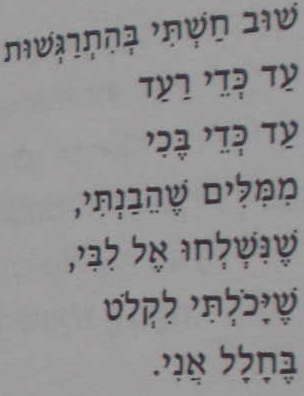
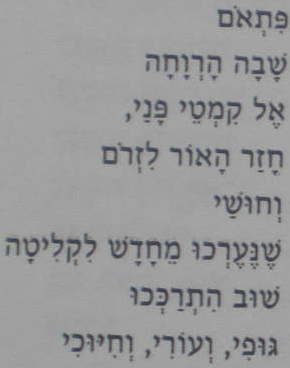
shuv khashti
But now, this
poem of Ilana, and parallel to it the other poem,
which both "touched " me, and then 5 minutes later,
when I - still in bed - continued to read a bit in my German Kol-Yisrael-Arevim-book,
I came across a verse which intrigued me: "pioneers..."
I opened the Hebrew original in the copy of the Hebrew Bible next
to my bed,
and now I was struck: These were the words, that "were
sent to my heart"!as
Ilana's poem says.
It's not the adverb "vicariously"!
It's the verb "to pioneer", which indicates my task!
khushai ....me-khadash
I
omitted the line about "light".
and replaced the last 2 lines [s. right]
when a tune added itself to both poems
See now in
2013 songs, August
The other words
that"were sent to my heart" are encoded in the chorus: Proverbs
3:6 and my modification: and
Shabbat,
July 21
The concept of "vicariousness",
or as my new song [2013
songs July Nr. 3] says: "Ich spuere, fuehle, weine an eurer
Statt" "I sense, feel, cry instead
of you, vicariously for you,"
has proven to be only a bridge to what is not new to me either,
but is beginning (!) to be grasped by me only now:
I am a pioneer, I am pioneering
both in front of the Children of Israel as in front of YHWH their
God
a pioneer of FEELING~VIBRATING~WOMBING~UNDERSTANDING
and not only of feelings , which have been cried and screamed,
but also of those, which should be expressed as joy and rejoicing,
like when I go into "my" garden or through "my"
Wadi
of Compassion
or look around my room from my bed
and see all those wondrous things and "systems" , all
these puzzles. Aviv Gefen said on TV in "Ma'agal
Dan Shiloh" on Shabbat Eve,
what dismay he feels seeing people all crouched (?) over their i-phones
and no longer seeing a sunset!
They glide their touch over the tiny screen to see a multitude of
virtual pictures,
but don't see, what or who is in their direct present.
For me, this judgment is not helpful,
it's me who has to be a pioneer
in seeing, hearing, smelling, touching
what is here with me in every moment!
I zapped into some beautiful music
by Mozart, piano, clarinet, violin
and I asked myself again, why am I rarely really full-filled by
music,
unless it's connected to words which touch my mind.
And I compared this with my incessant appetite for food.
Like my Body needs and wants food and "exercise",
so my mind needs food as well as "exercise".
I want to let go of judging myself for both,
as if both were a way to escape feelings.
I'm grate-full, that I never lack food
neither for Body nor for Mind. But what nourishment and "exercise"
does FEELING need and want,
to be in balance with Body and Mind?
As to my research on the term
"khalutzim" - pioneers in the Bible, see further down.
By the way: I now read about
Zionest pioneers
in industry,
without which the Zionist pioneers in agriculture
would not have been able to draw enough water for their orchards!
July
21, 2013 what is new now is,
a) not 'vicariously" ,
but "as a pioneer of evolution"
b) neither "plights" or "dramas"
or even"problems", "bugs","chores"
are the first step to feel and vibrate
but this, this "little feeling"-
either gladness and grate-full-ness
or dullness, "stamiut" or discomfort!
K.i.s.s.-log
Dec.15, 2008 "Since I KNOW
that I am a ray of the sun,
a wave of the one ocean,
a color of the one rainbow,
I desire to always be aware,
that the PURPOSE of attracting
--- a nano-problem in Body or Soul,
or a technical "bug", or "chores" like phone-calls,
or an interaction not chosen consciously, is:
--- to vicariously feel and sense this ,
to vicariously vibrate, move & sound this,
to vicariously accept & evolve this -
to vicariously being parental to this and not victim"
July
21, 2013 Having to get up slowly from my chair in front
of the computer
and walk slowly to the stove for getting a second cup of porridge,
slowly because of the pain in the joint of my hip,
forces me to become aware of what I feel.
I really should replace the "feel what you feel now"
with "become aware of what you feel now and then vibrate it".
Ever more often now people in interviews are asked:
'what do you feel with this?'
But, of course, this question always refers to something "big'
,
be it joy or sorrow.
July
22, 2013:
I need to add to every single file connected
to the book,
what has changed .
Up to now I only said, that "vicarious suffering" was NOT
Sacrifice of Life.
Even in Learn&Live,
Edith Stein, I repeated this.
Even the expression "to feel vicariously" , which I adopted
in recent years,
is misleading.
And yet without these 60 years of learning from the concept of vicariousness,
I may not have come to this new understanding: I am meant to become a pioneer of evolution in feeling~vibrating~wombing~understanding,
or in integrating consciousness
and sentience, thinking and feeling , in Body
In my book (German
p. 237, Hebrew p.250) I read about Jesus and Zachaeus So hat seine Identifikation
ohne Zweifel auf viele Menschen gewirkt:
D i e S t u m p f h e i t d e s G
e f u e h l s
musste einem wachen Bewusstsein vom eigenen Fehlverhalten Platz
machen. In German I use the term Fehlverhalten
instead of the English "wrongdoing" or
similar terms
for 3 reasons: a) "Verhalten" is not always "doing",
it might be "not-doing"
b) because the "Fehl" (connected to the word "verfehlen",
"to fail")
is close in sound to "fuehlen", to feel.
c) because it is not immediately associating "sin"
July
23, 2013
This is not enough, that someone becomes aware of his "failing".
Look at Rabbi, R. Yehuda the President, who
was sick for 13 years,
because he didn't show that calf enough compassion.
So far there has been no bigger "resolution of a picture"
than that of feeling guilt.
"To feel more", in general, might
mean:
to feel more my past suffering or my past "failing".
If suffering or "failing" are the consequence of "Lost
Will",
. i.e.
denied feelings, despised qualities, overridden needs and dwarfed
greatness both has, indeed, to be felt.
But why can't s/he feel it?
It would be like trying to climb a high mountain or swim a long
distance,
without having trained before.
If people do not get better at feeling, they cannot redeem Lost
Will .
This means, the "resolution" of feeling must be highly
"enlarged" (is this the technical term?) And this, this alone, is my task.
And it, obviously, cannot be taught by words.
I can only enlarge this resolution in my own life, moment by moment
See my two songs: "I
breathe and embrace every movement in my feeling"
and "ani
noshemet tzil, tzaeva, tzurah"
In
this research - first completed 41 years ago -
I can only hint at how
the central concept of "SIN" has
to be radically transmuted.
Sin is "Suende" in German, which derives from "sondern"=
to separate.
The actual "Suende" is "Denial", i.e. the separation
between Thinking and Feeling,
i.e. the lack of awareness - by ignoring, overriding, repressing -
of what I do not want in my life - a) feelings, b) needs, c) qualities,
d) greatness.
These denied parts of myself do not simply disappear ,
but survive in body and soul and all around me,
they even attract more of the same denials, become monstrous,
produce evil doing, perpetration,
or evil suffering, victimhood.
The redemption from "Sin", i.e. from "Denial" and "Lost
Will"-
and from there the redemption from suffering and death,
begins with learning to feel, i.e. to accept, "to womb" what I
feel,
to move it physically and then to understand...
In other words: I can allow myself to feel unpleasant feelings, needs, qualities,
only if I KNOW and PRACTISE - that every feeling, from the tiniest to the
biggest -
must be V I B R A T E D , i.e. physically breathed, sounded,
moved,
in order to heal and evolve, and then fulfill its task: to guide me and
to full-fill me.
Once there was a quantum-leap in evolution,
when humans understood that there was a connection between suffering and
doing.
Since they knew from the beginning (unlike humankind today), that the many
and the one were tied together,
their "solution" then was, to uproot the one evil-doer from the
community, so as to spare it the consequences.
The next quantum-leap in evolution, was,
when it was understood that this "solution" caused even more suffering,
and they evolved the idea of "reproach and protest".
This, also, caused more damage than benefit.
The "solution" people then came up with, was not an evolution,
but a re-volution, a re-gression:
it was to deny the connection between doing and suffering altogether
and to ignore the mutual guarantorship between the one and the many.
As the present time-period shows, this was/is a horrendous denial,
yes, the culmination of an absurd, monstrous illusion.
Now the time has come, to go down to the deepest roots of both:
the connection between doing/notdoing (=denial) and suffering,
and the connection between me, the individual, and everybody else .
addition on July 31, 2013
The root is the disconnection between the aspects of "God" or
humans:
Spirit-Will-Body --or thinking-feeling-sensing...
When Spirit/Mind denies feelings or needs or qualities and greatness,
then these feelings, needs, qualities and greatness become "Lost
Will".
Lost Will either undermines myself and - as its worst - causes "cancer",
or attaches itself to other people who are weak in their self-acceptance,
who then - in order "to do" something - produce havoc all around
them.
In
one of his shocking sermons of reproof and rebuke, Jeremiah[6:19]
expressed it ever so clearly,
that the plights and catestrophes which befell "this
people"
are
"the fruit of their thoughts"!
I'll give one - terrible - example of the fact,
that behind the horrid "slaughter of their
sons and daughters" [verse 37],
which Psalm 106
mentions as the culmination of an endless history of Israel's wrongdoing,
is DENIAL and JUDGMENT.
The judgment or belief was at
that time (and is in armies till today!!!! )
that people could live only, if the firstborns would be sacrificed.
This belief caused them to deny the most instinctive feelings of parents,
which is to do everything to keep their children alive!
While again re-studying what I wrote in kisslog2008-07-11
- in order to reach clarity about
"feeling>vibrating>wombing" vicariously,
I wondered if I should delete the text, which I quoted here in small letters:: But how would you be able to genuinely
take upon yourself the suffering of both "those who are acting out and hate themselves
and who feel victims all their lives" as your prayer-song says,[s.2013
Songs May Nr.1 ] if you would not train yourself first
and second and third
in feeling>vibrating>wombing
millions of "nano"-feelings/experiences of both,
the perpetration of ..., which you did not "see",
since you were often out of the house, busy with your peace-work,
and the victimhood of ...,
which you did not grasp into its abysmal depth, even after ... let you know
...
and despite your being "contaminated" for ever by your own horrid
stories
of having succumbed to sexual manipulation, though not inside the family.
Pioneer of FEELING - don't FAIL to FEEL
- verFehle nicht zu Fuehlen
......."The Servant's" task
is not to "suffer vicariously",
but to vicariously take on his people's and all peoples'
denied feelings of guilt and unworthiness
and thus to "intoxicate" them!
July
27, 2013:
No ! this is still too limited, or- using my new
metaphor,
it's looking at the picture in too small a resolution. My task is not to "intoxicate" people's
denied feelings.
My task is to be a pioneer of evolution in:
feeling>vibrating>understanding!
No more big dramas, but specific momentary feelings!
No more constructing judgments and beliefs,
in order to make sense of harsh experiences/feelings.
On the contrary: releasing judgments, so they will NOT
attract the harsh experiences/feelings over and over again.
A quantum-leap in evolution! I'm meant to be like that first creature,
that stepped out of the water onto land
Since I intuit, I should leave
behind the term "vicariousness", which served me for
55 years,
and replace it with "being a pioneer of Evolution in feeling~vibrating~wombing~understanding,
I return to "my" Hebrew Bible and research the terms
"khalutz",
"le-hekhaletz",
"le-hakhlitz"
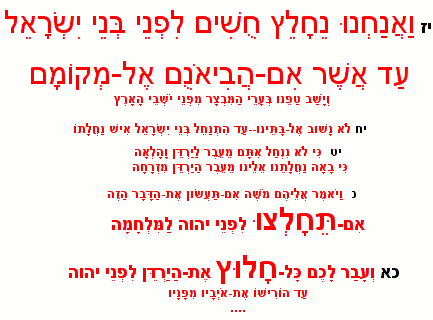
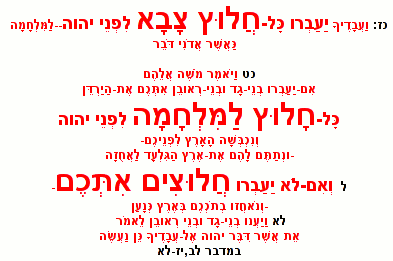
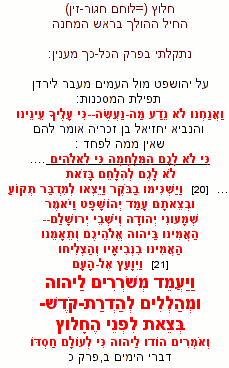
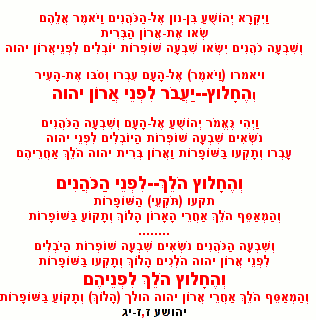
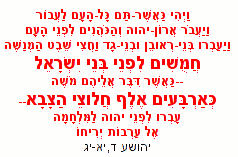
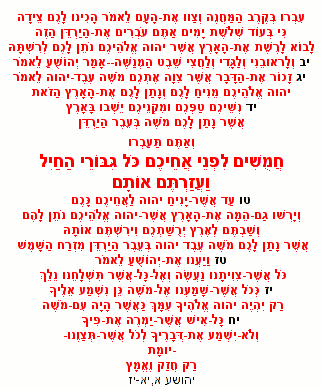
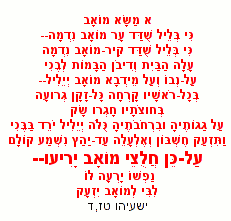
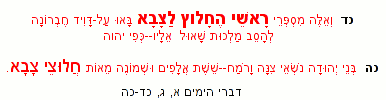
Research in July 2013 PIONEERS - khalutzim - IN THE BIBLE See above:
my progression from the term "vicariousness" to the
term "pioneership"
notes:
I refer to a video which I saw on Facebook,
where the participants of a band,
which performed at Mitzpe-Ramon,
roamed through the streets and shops
and asked people - humorously: "how frequently do you
sense
what you feel?"
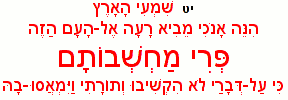
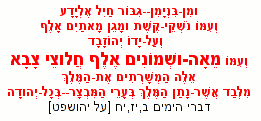
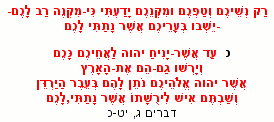
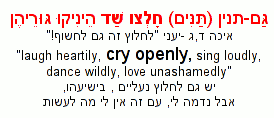
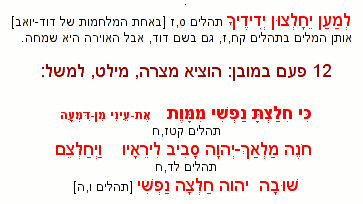
The double appearance of the rare root kh-u-sh
not in the meaning: to sense, but in the meaning to hasten
the one who trusts, does
not make haste Isaiah
28:16
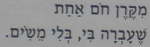
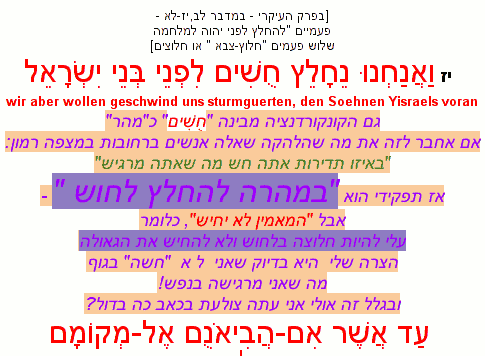
In this first context in which I find the verb nekhaletz
there is hidden a word, which is not really clear: khushim.
The translators related it to the verb "la-khush",
"to hasten",
but perhaps it relates to "la-khush"
-"to sense",
though the latter appears only in Job [as
a verb:
31:5, clearer as a noun:
20:2]
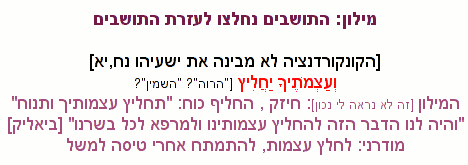
I would like to make a "midrash"
of "nekhaletz khushim"
and connect the khalutzim of armies with the khalutzim of this
time:
"Let's become pioneers in feeling, sensing!" see Part II, Chapter III - the Teaching
of Solidarity
August 14, 2013:
I did not have "time" to analyze these findings mentally.
What is important for me, is, how this composition inspires my intuition
concerning the understanding, that "I am a pioneer in learning
to feel"!
What a pretty coincidence, an interview today with Roi Halevi of
"Har-El"
I won't name or describe it! Just
open the video uploaded on August 10!
Dov Yannai introduced me to another "Har-El" pioneer:
Orna Horovitz!
"This is the woman who set up "Succah
in the Desert", and she knew:
"You lived there in your bus! How on
earth did you tackle bureaucracy!"
August 2, 2013 Ezechiel 39, 23
Israel have been and still are pioneering awareness,
the awareness, that no one is a victim of "destiny",
but what happens to him/her/us,
is attracted to him/her/us
by our denial ,
the denial of so many things in any moment of an erronous decision,
or the denial of feelings in hours, days, years, lives of non-decision,
like when we let it happen, that enmity grows and grows around us,
until we are attacked and "have no choice" but sacrificing our sons.
[maybe the following should be inserted in
"Waking the Tiger"] My progression from the term "feeling"
to "being aware of what I feel", or "la-da'at"
in the Hebrew double sense
of la-da'at:
to distinguish (between good and bad - the tree
of Eden)
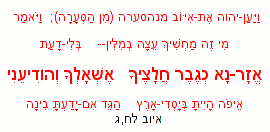
and to unite in body (Adam and Eve)
Walking back from the pool I - among other songs - rehearsed
the song "betakh ael ha-SHEM be-khol
libaekha ve-al binatkha al tisha'en" When I heard myself singing "ha-shen" (the
tooth) instead of "ha-Shem", I laughed,
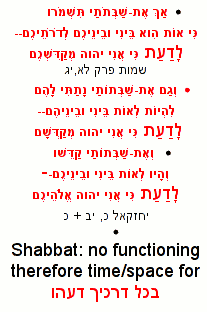
and when reaching "binatkha" (your wisdom)
I thought of "shen-binah"-wisdom-tooth But then came "the point": be-khol
drakhaekha da'ehu In all your ways learn-to-know Him,
and He will straighten-out your paths.
Be aware of what you feel in each and every moment. Neil
Diamond's famous song: "All I have is what I feel and what I feel
is what I am"
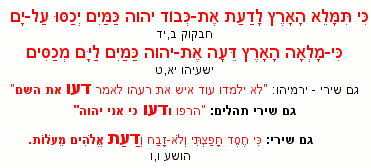
Wherever the Hebrew Bible says, that
"da'at elohim" - "yada'tikha"
- "da'ehu"
is what is demanded [See
2013 songs March Nr. 2]!
It is more than the knowing of the mind!
la-da'at [in
German: "erkennen"]
also means:
"knowing each other - man and woman!"
la-da'at in mind as well as in flesh
means:
to be aware of what I FEEL - in my Body.
to "know you", God-Shekhinah,
in Body.
To feel in every moment, is not yet sufficient understanding:
I need to be aware of what I feel, and in this "la'da'at
elohim", like I walk to the kitchen, fetch the grey
water jar, bring it to a planter next to the gate into my garden and while placing my feet carefully,
spreading my toes, so as to minimize the pain of my hip joint,
I keep saying: be-khol drakhaekha da'ehu,
or be-khol rigshotayikh da'ihu,
and then in between these aware feelings comes a feeling of pain or
shame
-without association, just out of nowhere, often connected to "child-abuse",
then this is the moment to not only be "aware of feeling",
fulfilled by feeling,
but to vibrate this 'dramatic emotion'- by breathing it, moving it,
sounding it,
and to "womb" it, accept, not judge, not ignore, not make
wrong the feeling.
That is how I may imprint in my brain once again,
that I am a pioneer of Evolution in learning
to feel. (please give me words that are less
cumbersome!
- what about an exchange of letters?)
My evolution occurs far from the changes that occur in the world
,
like that of the first creature that stepped on land from the sea,
Or even like any tree that grows in the earth, in darkness,
far
from any eye that sees or ear that hears.
see
an
old song of Proverbs 3,6
and the chorus of a new song,
2013 songs, August
sung in the original: drakhaekha-your ways
and in its"update": rigshotaekha-your feelings
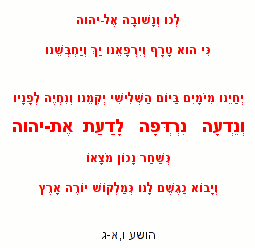
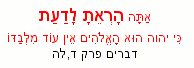
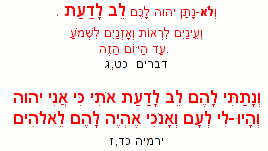
On my birthday I woke up with "my" psalm 139
{see in right frame: ve-nafshi yoda'at me'od}
put into tune in 1986, one
time and another
time
all these are verses, which I put into
tune the first two, which are almost the same
wording in 2 different biblical books
in "ve-gar
ze'ev im keves"
the third, Jeremiah, in the 3rd stanza of "Yesurun",
the fourth , in the 3rd stanza of Psalm 46, 2012
songs Nr. 6
The fifth, Hosea, is the beginning of a
2013 song (March Nr. 2)
This is NOT genuine emotion.
It is just more preoccupation with control that has leapt into the sensory realm. [I don't understand]
You are sad, because something happened that you did not like.
You are happy, because something came to you that you wanted.
You are worried, because something might "get out of control,"
or you became angry, and it was you, yourself that got "out of control!"
[I wonder, if
"control" is related to Godchannel's term "judgment"?]
Genuine e-motion flows gently, freely---
unhindered by the need or the desire for control.
It simply is what it is.
It also allows others to be what they are.
Being unattached to outcomes,
e-motion actually seems to move right through any obstacles,
like a fog moving through a sleeping city.
Each and everyone of you
has thousands upon thousands of e-motions
going on within you at any one moment.
However, most of you miss them ....
Do you wish to unblock those daily stalemates
that are playing themselves out in your bodies and minds?
All you have to do is shift your attention away from them for a moment
and begin to focus upon the more subtle energies
that have been flowing in and around you since the very beginning.
One must learn to focus upon what is moving, not what is BLOCKED. [Mirjam
Goldberg: Konzentrative Bewegungstherapie?] You must learn to read between the lines!
What you focus upon is what gets perpetuated and energized.
Blocked "feelings" were created to slow you down.
They are self-imposed tethers that have been installed
to keep you from advancing in your consciousness too quickly.
You will never be able to solve them.
And seeking to understand them, beyond what we just told you, is even more of
a waste of time. [I don't understand!~~~~ Nov. 24, 2010: I understand
a little more now!]
Whatever "understanding"
you may require, concerning a genuine e-motion,
will be given to you as you move along with it.
It is as though you are a swimmer, hanging onto the fin of a dolphin, being
pulled along in its wake.
You feel what it feels, even as its thoughts become your thoughts.
The ride is over when you begin trying to control this creature---
...
Dealing properly with e-motion becomes an art unto itself.
It begins with a decision to look away from what screams at you--
-from what demands that you react---
opting instead to focus upon what sings to you and inspires you.
Then, once your energy has cleared itself and become calm,
you can deal with your world with new eyes and an open heart.
[They say nothing about healing, healing God, healing human,
and nothing about Body's role in it.
So who is the one, who'll "focus attention " elsewhere?
Isn't it Body?
But what they say about "control" is very helpful].
August
9, 2013 Purposes of my present
predicament with my hip-joint and my teeth
(1) There is much to cope with for me, now,
My daughter-in-love thinks
that I did not behave as a partner to my body,
and that therefore
"the sceleton" (not the health) is damaged.
She asks me to inquire
about megagluflex + G10
and agree to take these "food-additions".
I cannot possibly convey to her,
that I attracted these "problems",
teeth and hip-joint,
so as to learn to feel more,
so as to be a pioneer of evolution in feeling, what others still can't
feel.
Even when I still had my own teeth,
I always ate slowly,
so as to enjoy taste and food longer and more.
But I definitely never walked slowly,
and the pain in the hip now forces me to do so,
so as to be aware of what I feel
from step to step
and from pain to non-pain to pain.
If am wrong, I ask YOU
to send me messages or experiences!
(2) Solidarity with the "old, fat and ugly"
There is actually a very simple purpose of this
predicament,
one that has been discussed by the Sages concerning sickness and pain:
it teaches you humbleness, compassion and solidarity !
Why do I, out of all persons, need this? "Laughter
is the final stage of healing",
says Godchannel,
and, indeed, I've always been aware during the 7 years of
sitting in the Jacuzzi almost every day and judging, judging,
awarely judging the "old, fat, ugly people" sitting there with
me.
I even felt disgust sometimes and could only laugh at myself.
I also laughed and still laugh, when I see myself competing!
This is the one and only realm, I want "to be better",
i.e. "younger than other people my age",
"healthier than other people my age",
"good-looking more than other people my age"
and most ridiculous, since I've never been keen on living,
"living longer than other people my age".
Perhaps, since I also judged myself for this competing,
I attracted the "blai" (wear and tear)
in the joint of my hip and my lower back and in my teeth,
so as to feel solidarity with the people who are old, ugly and sick.
(3) But I can already guess, that there is a third purpose
for my painful handicap:
which I, indeed, have to cope with
on an individual, personal level:
accepting that my children and landlords
d e s i r e to help me,
and if this gives me the feeling
of being dependent on them more than is necessary
or if it means to give in to their advices
more than I would do naturally,
then this is something I have to understand
and see if I can accept it.
Please help me with this and prevent me
from making it more difficult for my children,
as it is anyway to have this mother in their drama.
My problem has always been,
that I wanted to give too much. [Last shameful lesson with Gabriela, the Hungarian
new immigrant in my neighborhood, in January 2013]. Maybe, the entire "guarantorship
-responsibility"
is not about "doing" for others
but about "receiving" from others? I choke on this possibility.
The background to this triptych
are photos of my thumb, made in 2002
The
Purpose of HEALING - K.I.S.S.
- as stated 12 years ago - was and is
to help me and my potential P E E R s
"to HEAL ourselves into WHOLEness,
and - by extension - all of CREATion!"
2013-08-13 Since
Oct. 2012,
I almost succeed to
heed: "cease
creating New Manifestations!!"
and to focus my learning~~~living on: redeeming"Lost Will" +
dissolving"Guilt".
I pioneer the evolution of
feeling~vibrating~'wombing' human pain and shame, fear
and powerlessness, so all emotions
can heal > evolve > guide us all!
Intro
to Healing-K.i.s.s. 2001-2013
and Overview of its main libraries
SEARCH on both websites: Healing-K.i.s.s.
& ARARAT-HEART
If you look for a word or a name on any of the 1400 pages,
click ctrl/F and put a word in "FIND"
I practice wandering between linear time~spherical "time"
by following the 365 pages of K.i.s.s-log
2008/2012/2013
Until
April 15, 2012 - I naively believed, that
25 years of focusing on "Healing
into Wholeness" had healed me.
But the next 80 days whipped me towards
the disillusioning insight,
that the presence of GUILT
indicates there is still DENIAL of feelings,
and that s
in & around me is still suffocating living~loving.
Yet I feel~~I know, that LOVE's Evolution is close to
a quantum-leap! "they have
lost many of their powers because Guilt told them
it was not right to be what they were, ...
Self-acceptance is what they seek.
Guilt and blame, pride and shame
are all imbalances around the search for self-acceptance.
[Violet Book
p. 144]
"The recognition of guilt comes
with the evolution of love
understanding it self" [Green
Book p.3-4] "Guilt
is held in place by judgments. Release
the judgments, and the guilt goes too..." [quoted
from
Godchannel.com in "Judgment
Release" 2005]
Back
to "HOME", water from above merging with water from
below, which symbolizes that this is the time for SPIRIT and WILL
[feelings] to unite in the HEART of BODY on EARTH
I t i s t h e
S K I L L - t o - F E E L w h i c h
i s h e r a l d i n g "
H U M A N I T Y ' S A W A K E N I N G
It now has become
simplified [below], but - in this
context of my diary - I want to also guard the 2012 version [above]:
The
Purpose of HEALING - K.I.S.S.
- as stated 12 years ago - was and is
to help me and my potential P E E R s
"to HEAL ourselves into WHOLEness,
and - by extension - all of CREATion!"
Intro
to Healing-K.i.s.s. 2001-2013
and Overview of its main libraries
SEARCH on both websites: Healing-K.i.s.s.
& ARARAT-HEART
If you look for a word or a name on any of the 1400 pages,
click ctrl/F and put a word in "FIND"
I practice wandering between linear time~spherical "time"
by following the 365 pages of K.i.s.s-log
2008/2012/2013 as well as all other files of Healing-K.i.s.s. &
Ararat-Heart
2013-08-15:I
focus my learning~living on
becoming a pioneer of Evolution in feeling~vibrating~'wombing'--with
awareness
human pain and shame, fear and powerlessness,
so feelings can heal >evolve >guide>fulfill us
all!
Back
to "HOME", water from above merging with water from
below, which symbolizes that this is the time for SPIRIT and WILL
[feelings] to unite in the HEART of BODY on EARTH
I t i s t h e
S K I L L - t o - F E E L w h i c h
i s h e r a l d i n g "
H U M A N I T Y ' S A W A K E N I N G
What do these terms -"my Purpose" and "My Focus"
- mean?
I not only keep experiencing and exploring what comes into my living~thinking
but I'm also very disciplined in limiting and eliminating both: input
and output,
the input
of info that is "interesting", "important", but
not benefitting my goal, the
output of actions and almost
all interactions, of teaching and almost all creating.
Also, the need "to function" - household, garden - is turned
into all kinds of games.
Thus I have time to "walk humbly-hatzne'a
lekhet", yes to limp slowly-litzlo'a lekhet
and become aware of what I feel, and when what I feel, needs to be vibrated~wombed!
Thus I'm reaching a greater and greater "resolution" of the
picture of Manifestation,
by becoming aware of the microscopic details of the movement of energy,
called feeling
("e-motion"
could be a fitting term, but since it has been affixed to the "big",
the "dramatic" feelings,
I want to distinguish between these "emotions" , of which people are
aware more or less and the feelings - the flow of energy
- in every moment of my living, even when I dream while sleeping.)
August 14, 2013
Two coincidences
I traveled to Beer-sheva, in order - after 10 years - to meet Dov
Yannai,
who was to give a lecture at the ceremony of handing over the certificates
to Ethopian students who had studied with the NGO
"Startup".
Though Dov had looked for the address before meeting me at the bus-station,
he had difficulty to find the Khalutz-Street 33 in the old city of Beer-sheva.
I laughed! "Khalutz" ! Pioneer!
In the make-shift place between two old buildings, where the students
sat,
I saw a big poster in front of me: I didn't have a camera with me, but I now found
it rightaway
on the website of this NGO of modern, impressive pioneers
Another coincidence happened
when I got up from bed
and - as usual - grabbed the book
the turn of which it was today
to be looked into in order to be nourished.
It was a German translation of the Qur'an,
but I didn't even look into it,
since a clipping attracted me,
which I must have written 30-40 years ago, about suffering and vicariousness in Islam!
I copied it to the page
with the chapter about "The Servant",
Isaiah 53
I woke up with these beloved lines in
Psalm 139, which I sing
[probably because of the research about "la-da'at",
s. above.]
The book, the turn of which it was to be grabbed from my shelf, was my
edition of excerpts from Franz Rosenzweig's intense work
before his death -on the translation of the Bible with Martin Buber.
[see more in bundle 13 of "kol Yisrael arevim
zae la-zae"]
I wanted "a sign" and opened p. 300, "List of Biblical
Words",
to which the passages, excerpted by me, payed attention
My eyes fell on dealt
with twice:
Genesis
17, 1-2; 6; 20 [Nr. 44]
Following the command of "walking to-and-fro
and being whole", which is
so meaningful to me,
I find the - doubled - me'odthree
times, for both - Abraham and Yishmael!!!
Deuteronomy
6:5[Nr. 141] The second time, me'od
appears
in my Rosenzweig edition,
is "of course" in the "Shma' Yisrael" "...So liebe denn...
mit all deinem Herzen, mit all deiner Seele,
mit all deiner Macht "
My purpose is -
to be a pioneer of evolution
in feeling awarely,
in feeling
~vibrating
~wombing
~understanding,
in
da'e-hu bekhol drakhaekha
=
da'e-hu bekhol
rigshotaekha
A
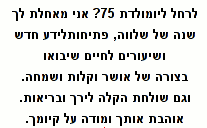
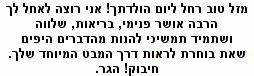
meaningful SMS -blessing from starchild Tzippi:
And from Hagar, my stepdaughter's daughter
I
had wanted this last composition to be the bombastic summary of my birthday
feeling-thinking
but then I couldn't fall asleep,
because I needed to digest all the interactions, so rare now, because
I myself am limiting them:
3 little sweet gifts from my
landlords, including a teddy-bear, the only one, I think, I got in
my life,
short e-mail and SMS exchanges with Ra'ayah,
my daughter-in-love, Ayelet,
my granddaughter, Dita,
my stepdaughter, Dov
Yannai, whom I met again, Na'ama Ya'ari, Ya'acov after 13 months...
a long letter in English from Barbara,
my classmate, old as I, more handicapped than me,
who was such an "Angel on the Abyss" during "Noah's
Shore",
and 4 hour-long phone-calls, with loyal Felicia,
who knows that our relationship is not mutual,
with Gadi Lybrock
who updated me about all the good news about Mitzpe-Ramon and his family,
with Lior
Oren from some wild place "in the Territories" near Jerusalem.
who knows how to listen,
and with Rotem,
my granddaughter from Modi'in, now 5 months in the army as an army
journalist.
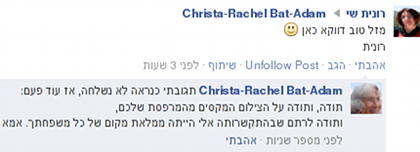
Late at night... I discovered. ...a sentence.... with a smiley.... from
my daughter.... on Facebook....
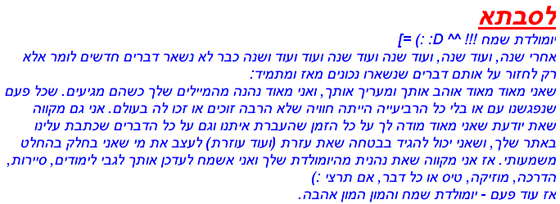
and a poetic letter that says everything about "my former grandmotherhood",
from Itamar, her son, now like Ayelet 15, two grandchildren of what was
once the "Quartet".
[ Yael "forgot" my birthday,
but compensated greatly a few weeks later, with her blessing and - yes-
with her 2 days visit!]
When I woke up long before dawn and had enough of turning, twisting, moaning,
I opened my recorder on one of the channels where I record "things
to think about",
and this is what I found! underlining my "craving to be consistent",
for lo! - the word "pioneer" appeared already
in a Communication with
Deity in Dec. 2008
"....Second: Your main talent is put to use
intensely, constantly, continuously and awarely:
the talent to feel all there is to feel and to evolve feelings in a way,
that you have become a pioneer of humankind
in understanding the conditions of heavon on earth:
to feel zest-full and full-filled all the time
and when a cloud comes or even some hail,
you just enjoy the feeling and- very important
- you let Body do work via any of its thousands possibilities." Yes this is what I understood again this
morning: The very experiencing of my feelings is my creative act,
and so is the movement in Body, [s.2013
Songs July Nr.3)
Later
I found another entry: "Heritage 2012" perhaps directed at
me indirectly?
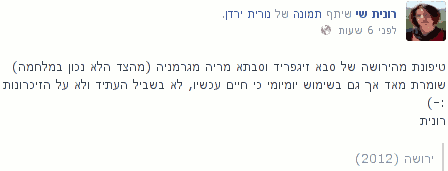
She mentions "Grandfather
Siegfried and Grandmother Maria from Germany ( from the wrong side
of the war)" . It was in 1976,
when my mother
was finally trans-ferred to a home,
that I chose this "Meissner
Porzellan" in her flat and brought it to my
home in Israel
From this day, July 11, 2013 onward -
- - - till August 27
- before and after my 75th birthday on August 15, 2013
I was being jolted into re-understanding my vocation:
All my former goals since the ages of 7, 13, 27, 50, 67,
were meant to create training-grounds for becoming:
a pioneer of Evolution
in learning-how-to-feel.
It is fitting, that I could squirm
myself towards this understanding not in a linear way.
And so now - on Yom-Kippur 2013 - on
the 17th FELT day of the next 15 FELT years,
I want to collect, harvest and savor the fruits as they ripened
- as - insights-in-stages,
just like the fruits of my pomegranate-tree have been ripening since
July 11 till now!






















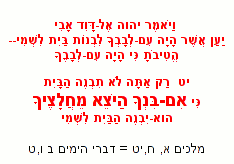
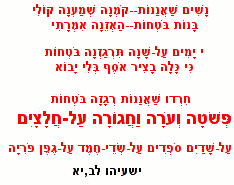


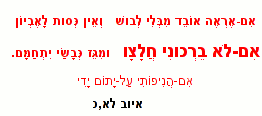
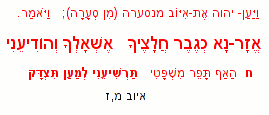





 dealt
with twice:
dealt
with twice: