I focus my experiencing and awareness on being
"a pioneer of Evolution in
learning to feel":
I let my Body vibrate and my Heart 'womb'
pain, shame, fear, boredom, powerlessness,
so feelings can >heal >guide>fulfill>evolve,
and ~~~ offer ~~~"goldmines"~~~ to us all!!
"I
want you to feel everything, every little thing!"
Re-edited
on July 23, 2013----------- In
this research - first completed 41 years ago -
I cannot update, how the central concept of "SIN" has to be radically
transmuted.
Sin is "Suende" in German, which derives from "sondern"=
to separate.
The actual "Suende" is "Denial", i.e. the separation between
Thinking and Feeling,
i.e. the lack of awareness - by ignoring, overriding, repressing -
of what I do not want in my life - a) feelings, b) needs, c) qualities, d) greatness.
These denied parts of myself do not simply disappear ,
but survive in body and soul and all around me,
they even attract more of the same denials, become monstrous,
produce evil doing, perpetration, or evil suffering, victimhood.
The redemption from "Sin", i.e. from denial and "Lost Will"-
and from there the redemption from suffering and death,
begins with learning to feel, i.e. to accept, "to womb" what I feel,
to move it physically and then to understand...
In other words: I can allow myself to feel unpleasant feelings, needs, qualities,
only if I KNOW and PRACTISE - that every feeling, from the tiniest to the biggest
-
must be V I B R A T E D , i.e. physically breathed, sounded,
moved,
in order to heal and evolve, and then fulfill its task: to guide me and to full-fill
me.
Once there was a quantum-leap in evolution,
when humans understood that there was a connection between suffering and doing.
Since they knew from the beginning (unlike humankind today), that the many and
the one were tied together,
their "solution" then was, to uproot the one evil-doer from the community,
so as to spare it the consequences.
The next quantum-leap in evolution, was,
when it was understood that this "solution" caused even more suffering,
and they evolved the idea of "reproach and protest".
This, also, caused more damage than benefit.
The "solution" people then came up with, was not an evolution, but
a re-volution:
it was to deny the connection between doing and suffering altogether
and to ignore the mutual guarantorship between the one and the many.
As the present time-period shows, this was/is a horrendous denial,
yes the culmination of an absurd, monstrous illusion.
Now the time has come, to go down to the deepest roots of both:
the connection between doing/notdoing (=denial) and suffering,
and the connection between me, the individual, and everybody else .
My PH.D.-Thesis, 1966-1982, delivered
in Hebrew to the Jerusalem University 1972 Original Theme,1966 : The Idea of VICARIOUS
SUFFERING as an ANSWER to INNOCENT SUFFERING
(i.e. my coping with the holocaust).
Final Hebrew Title 1972: "The PERCEPTION
of SUFFERING and SOLIDARITY
with the SUFFERERS
in the Thought of the Jewish Sages from the time of the second Commonwealth
till the End of the Talmudic Era"
(i.e. in Bible, Apocryphes, Qumran, New Testament, Talmud, Midrash)
"All
Israel are Guarantors for Each Other" Maryam, alias Christa-Rachel Bat-Adam,
married Rachel Rosenzweig, born Eva-Maria-Christa Guth
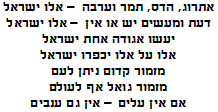
Etrog,
Myrtle, Date, and Willow
-- these are Israel!
Knowing and doing do exist or do not
-- these are Israel!
They shall make one union - Israel!
They will atone for each other -Israel!
An ancient psalm was given to the nation!
A redeeming psalm also for the World!
Without leaves- there won't be grapes!
The Cross: my old belief in struggling!
The Etrog: my rejoicing in fulfillment!
English
Summary
and English Digests of the Chapters
THE
PERCEPTION OF SUFFERING
AND SOLIDARITY WITH THE
SUFFERERS in the Thought of the Ancient Sages of Israel
till the end of the Talmudic Era
By R
a c h e l R o s e n z w e i g
Supervisors: Prof. David Flusser and Prof. Shmuel Safrai.
Subject: History of Jewish Thought.
Introduction
to the conversion of these texts of 1972 into webpages in 2002
2002_09_25 ; last update: 2009_07_07
For
lack of an English edition of my German/Hebrew book,
I'll quote here the English Summary of my Ph.D. thesis,
which I had been obliged to prepare,
when delivering the thesis to the Jerusalem University it on
Purim 1972.
Since my English then had gone underground
because of the two new languages, Hebrew and Arabic, I had to
learn,
if I wanted to take responsibility for
my new community,
Israel, it was my husband, Rafael
Rosenzweig,
who translated the summary and digests.
Among
the few thing I'll change in his translation
are his terms for'arev="bondsman"
and for 'arevut ="bond". As
I've explained -
I'm translating arev
as"being
a guarantor", and 'arevut
as "guarantorship".
I'm not happy with the terms "individual" for yakhid
and "outstanding individual" for yakhid-segulah,
because this translation misses the connection
between yakhid as opposed to tzibbur
=
community
and yakhad= together.
But
so far I haven't discovered how to convey in English this immensely important concept
petrofied in the Hebrew language:
the concept of how the uniqueness of any one person
follows from his/her relation to his/her
community.
S U M M A R Y
The wise is conscious of his suffering
and tries to find a way to cope with it.
But is he conscious of his fellow's suffering as well,
and capable of identifying with the sufferer?
Israel's sages' mosts immediate concern was
for the suffering of their community.
From its very beginnings,
the characteristic strength of Israel's philosophy was rooted
in its frank and courageous confrontation with the nation's fate.
It is not by stories about heroes or by dreams of victory
that Israel's literature is defined,
but by reproofs and consolations.
Those who reprove are not hostile observers
from the outside,
like some Christians, who developed an ideology of anti-solidarity
directed against suffering Israel,
thus negating the mission of their master to his people.
Neither are they those members of the Dead Sea Sect,
who "segregated from the men of evil".
In each generation, Israel's "reprovers" (Ez. 3,26)
identified with the suffering and practiced solidarity
with their community.
Their reproofs as well as their consolations
are consequences of their solidarity.
Solidarity is not to be understood
as an ethical requirement or as a divine duty,
but as a matter of self-interest, a fundament of life.
Solidarity is the necessary consequence
of the "Law of Mutual Guarantorship".
This natural law states,
that man's fate is not only determined by his own actions,
but also by those of his forefathers,
by those of his fellows
and by the actions of his community [and especially their rulers].
Also, the suffering of a community might be the consequence
of its being guarantors for the misdemeanours of an individual.
Whoever recognizes this law,
which binds a man to his fellow and to his community,
must identify with his fellow
and practice solidarity with his community.
On the other hand:
unless identification with the sufferers
is translated into individual responsible action,
directed at the prevention of suffering
or at its relief,
identification is entirely without value.
For this reason,
the strong identification of the sages of Israel with their community
did not provoke them into any kind of "collectivism",
but, to the contrary,
educated them towards individuality [uniqueness] and responsibility.
The individuality [uniqueness] of man is, therefore,
a direct consequence of the Law of Mutual Guarantorship.
Just as the individual[yakhid]
is capable of damaging his group,
he is also able to rescue it.
Everybody must see himself as a potential Abraham.
However, only outstanding individuals[yekhide-segulah] have ever and fully realized this aim.
The perception of the nation's suffering
did not leave much scope
for that of generally human or of individual suffering.
Suffering common to all human beings
failed to bring about international solidarity.
The individual's suffering occasioned judgment, not identification.
True: in practice,
assistance to the suffering, especially for the poor,
was well organized,
but in general the approach to the suffering fellow
was not prompted by the idea
that "he is like I am, his soul is like mine".
They who demonstrated solidarity with the suffering individual,
like Jesus of Nazareth and Rabbi Joshua ben Levy,
lit a beacon in the night.
This is a strange fact,
since the sages themselves showed a thorough understanding
of the biblical principle of identification, and taught it as well.
Identification is not a"commandment", and be it the most important one,
but it is denoted as "an important
principle of the Torah" - meaning it is the very base for all
morals. "don't oppress the stranger,
for you know the stranger's soul,
for strangers you have been", [Ex
23,9]
Solidarity also links the community
and the individual,
for the community depends upon the individual.
In biblical society,
the sinner was"uprooted"from his nation,
in order not to make his community a guarantor for his sins.
Experience showed,
that escape from this guarantorship
is not achieved by getting rid of the sinner,
but by"reproving"him,
as an expression of solidarity.
In this respect,
the sages went very far indeed.
They prohibited the extradition of an individual to foreigners,
even if he was a proven criminal,
for "it is better that all should
perish,
but there will be no extradition of a single soul from Israel."
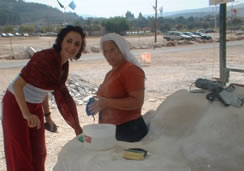
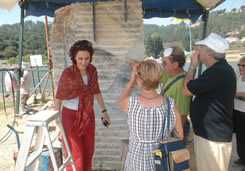
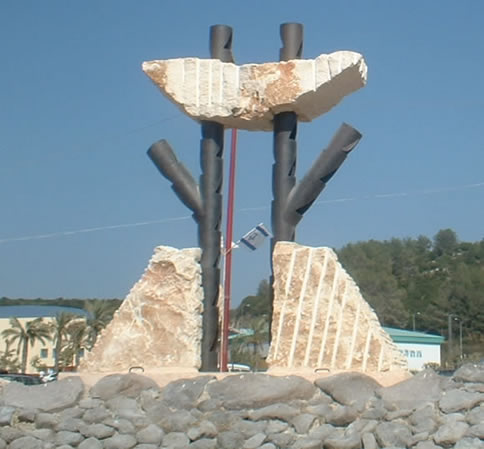
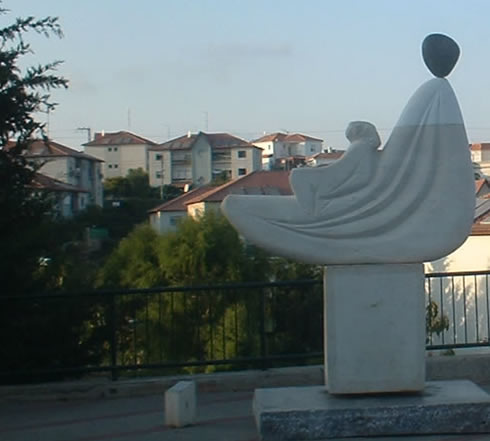
Efrat, my daughter-in-love, was
responsible
for the production of the Festival of Sculpting during the Feast of Succot
at Ma'alot-Tarshiha
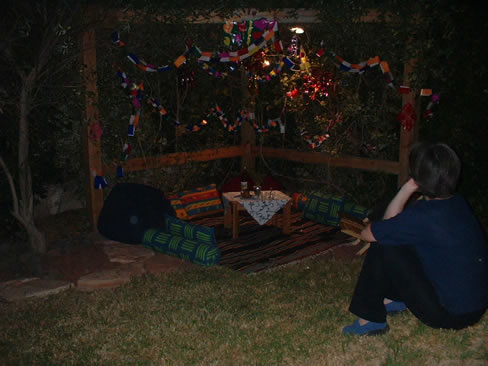
My daughter's succah this
year, in which we celebrated the Eve of Succot
2002_09_27 - Feast of Succot
The message of Succot is the message of my book.
I did not go-up to Jerusalem as did pilgrims from Israel and from
all the nations ~ I
did go up to Ma'alot
(=ascent), a small town in the Western Galilee,
with its original population from Marocco and Rumania (50%)
and its new immigrants from Russia (most of the rest).
Ma'alot for me replaces Jerusalem at the present time.
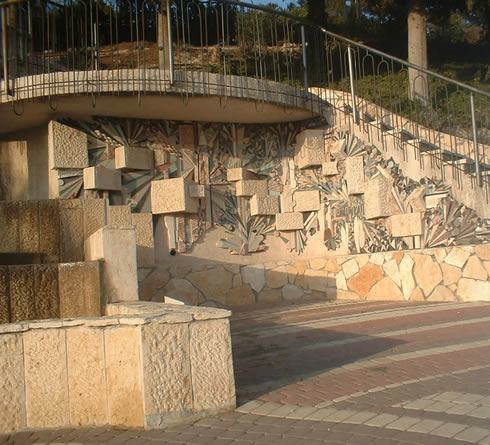
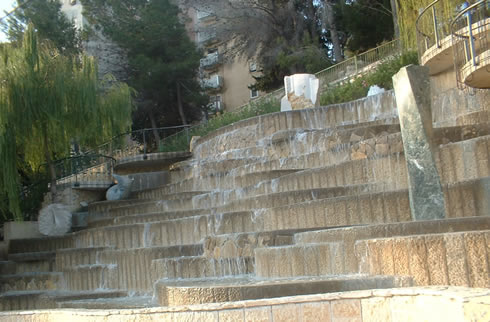
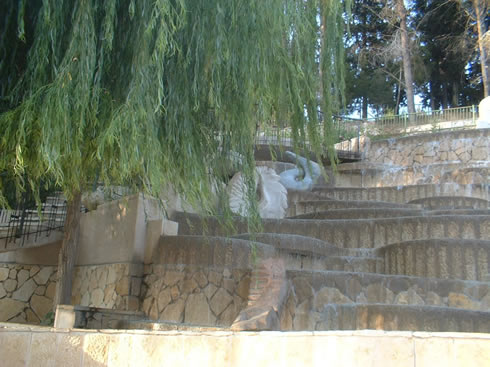
The ascent and descent of
water as well as of people at Ma'alot
And there is
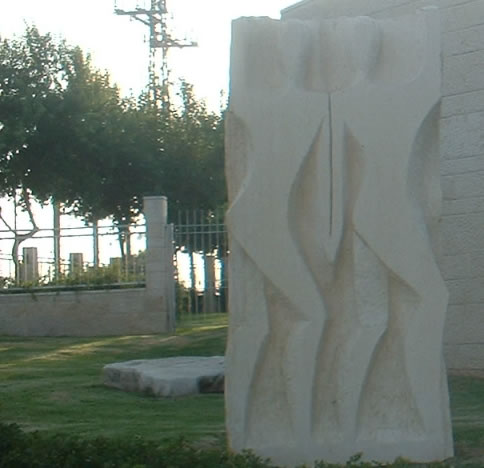
the Festival of Sculpting during the Feast of Succot.
For 10 years it has been international, this year - 2002 - fear
kept sculptors away.
Already 120 sculptures in Galilee-stone ornament the town.