|
See further down 2012
the last three of
The
8 RIGHT USE OF WILL Books
Overview of and Links to the Pages of My Community: Desert Vision - Succah
 Parting
from its realization in the exterior World
Parting
from its realization in the exterior World A DESERT PEACE PROCESS - 2002 - THE ROAD
Walking the 7 km
road from Avi to Gadi on 2002_08_24
2002_10_14-16 ; last update: 2003_03_01
Walking this lonely road brings up so many memories and emotions.
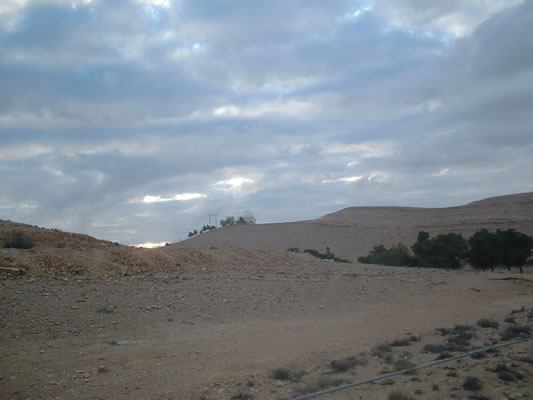
I'll start with 2 photos taken the evening before from the south west hills
opposite the Succayah.
They point to the east, to the road from Succah-in-the-Desert to Mitzpe-Ramon,
Gadi's town.
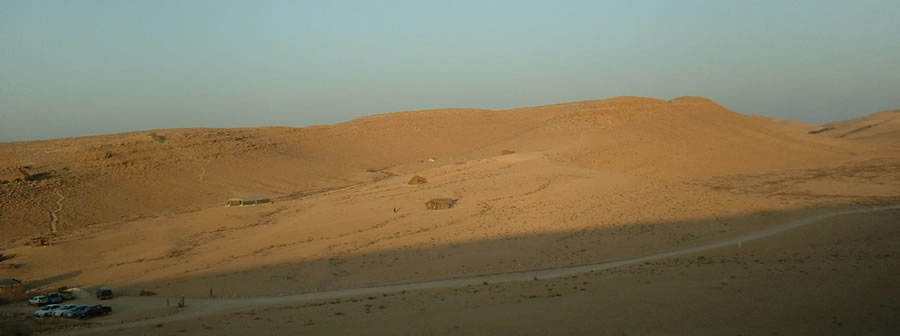
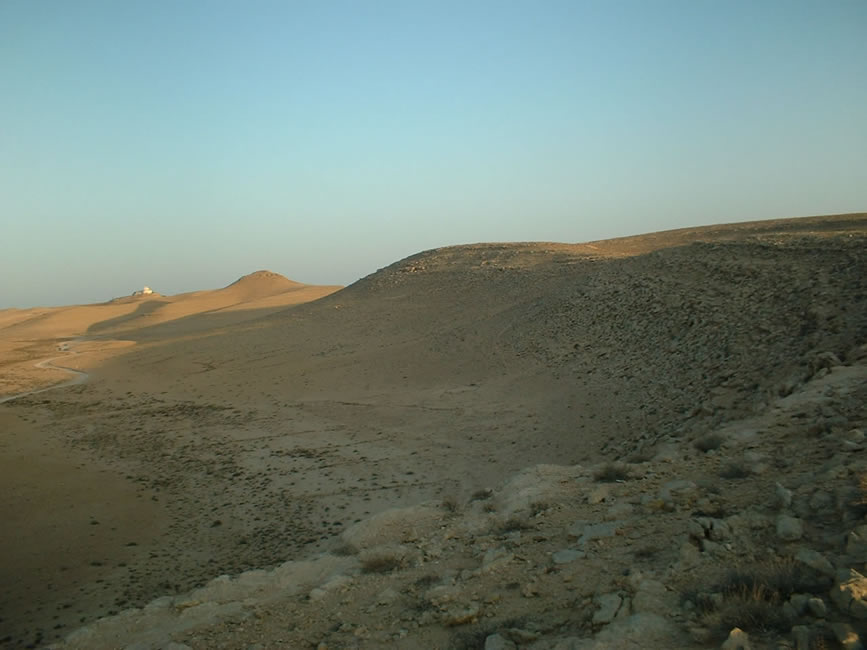
Ancient terraces in the wadi;
spots on the slope where herds gathered ,
Mount "Lekh-Lekha" to the right of the Observatory.
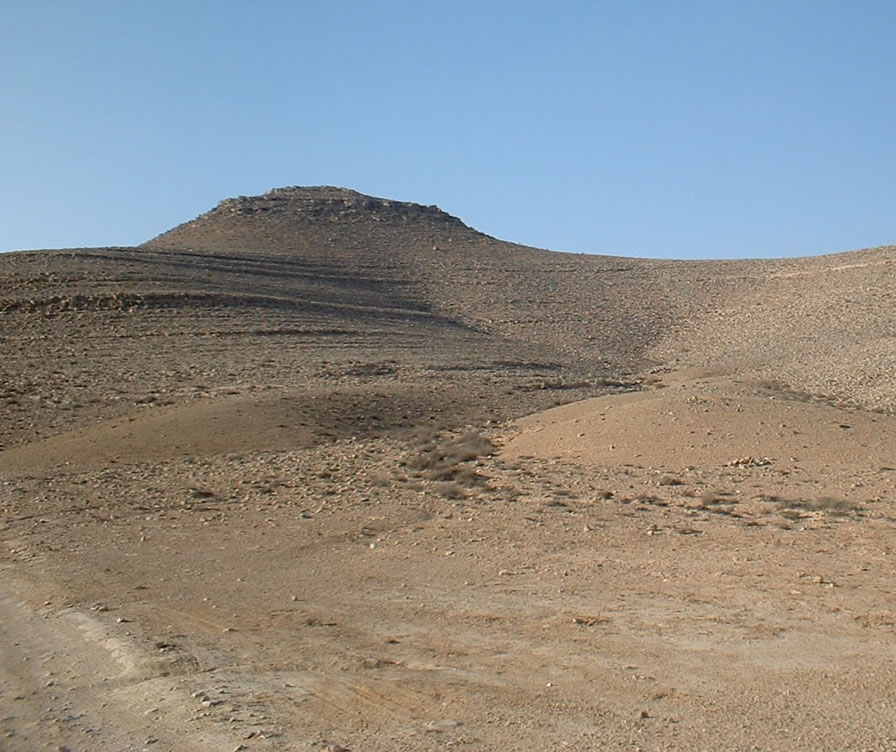
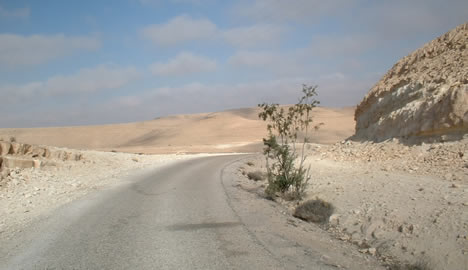
The 2,5 km dust road passes by the
high hill, which I came to call "Mount Lekh
Lekha",
after Yaron's theater workshop - in 1992 - had played the "Binding of
Isaac" [Genesis
22],
using the whole area, but imagining
the place of the NON-Sacrifice on
a rock of this hill.
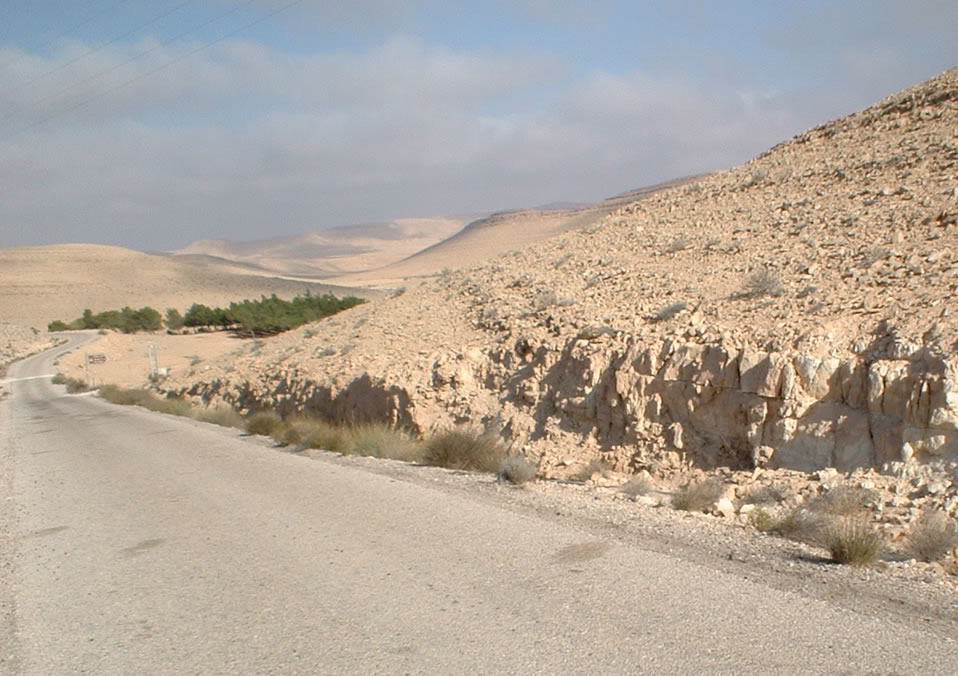
Looking
back to the now official sign "Succah in the Desert" at the turn
to the dust road.
The little grove behind it was - like several others - planted by the "Keren
Kayemet Fund",
officials who started to reforest the country a hundred years ago and cannot
grasp the fact,
that the desert needs to stay the desert, if we want it to serve us as the
future hosting space.
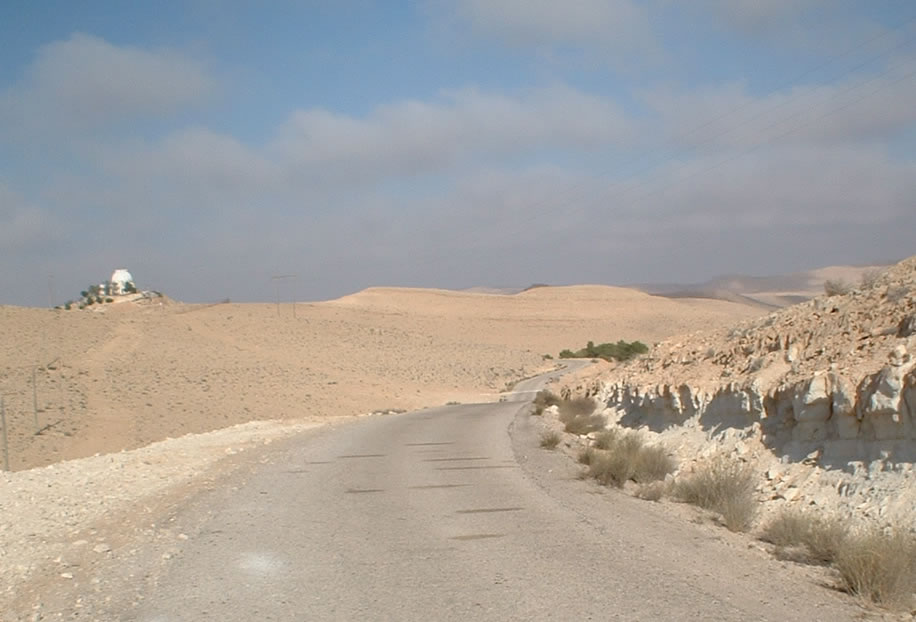
The road ends at the Observatory and so does the unburried water pipe running
along to the right.
In the beginning I tapped water from an outlet for the Bedouins which is close
to the town.
Then the municipality installed a tap near the grove for Succah in the Desert,
from which we filled the two 300 liter tanks in the jeep.
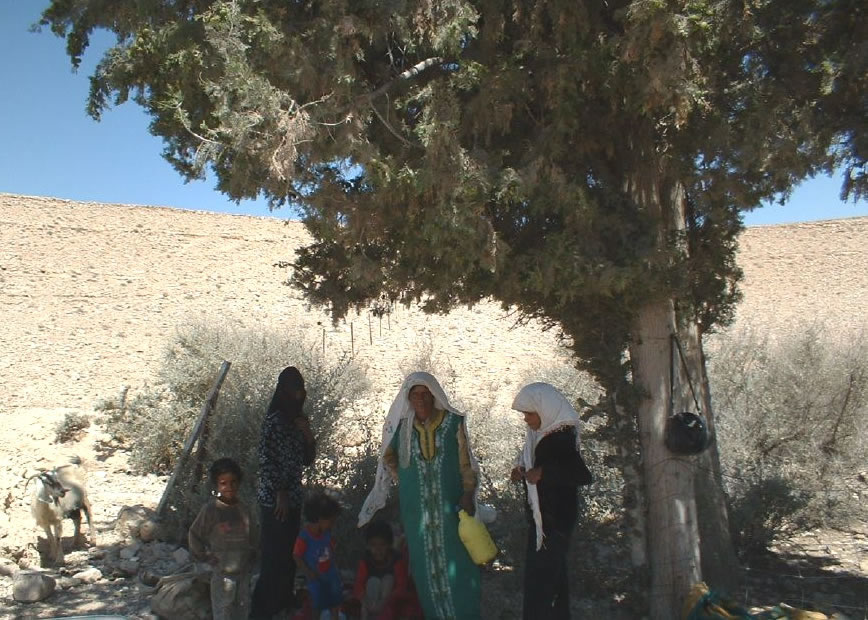
Not in the morning, but in the afternoon, with Gadi and Efrat in their landrover,
we met Fadiya, her kids (her daughter Hamda
veiled herself the minute I asked if I could photograph them)
and her kids (a herd of sheep and goat, though only one is showing here)
taking water from the tap under the cypresses, the only place from where they
are allowed to do that.
The Bedouins in Israel - like elsewhere in "civilized and orderly"
states - have been evicted from the desert and confined to artificial "Bedouin
towns".
but in Mitzpe-Ramon one branched-out family has the priviledge to live and
graze, though in a meticulously defined area.
Once they asked me, if they could take water from our tap, since it was so
much closer to where their herd grazed then.
They would pay their share in the bill, of course.
Unfortunately my enemy, the ranger, discovered them there~~~~~~~
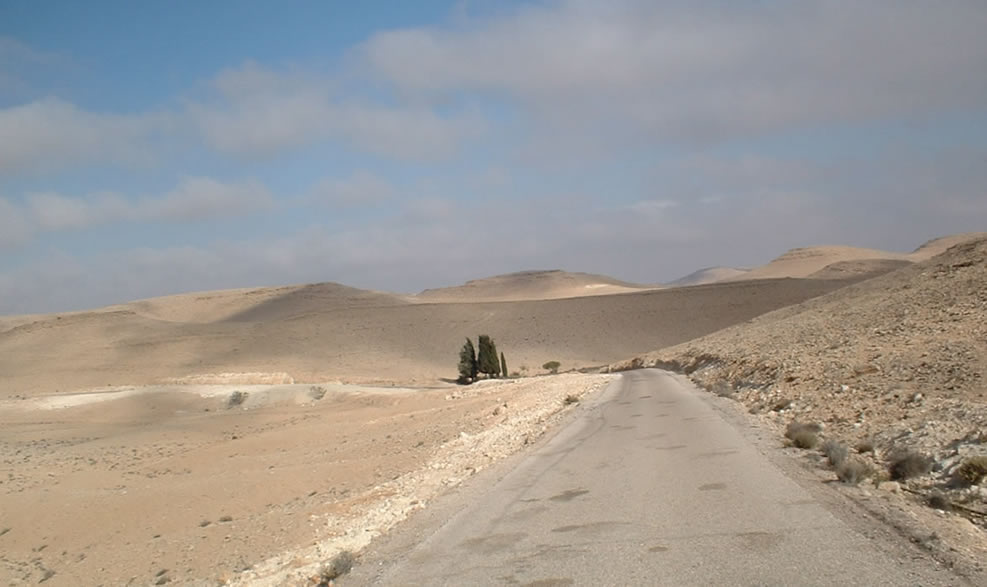
The shadows of the clouds driven by the wind race over the hills and wadis.
Where the cypress trees grow, a rarely used trail leads to the Alpacca-Farm.
 |
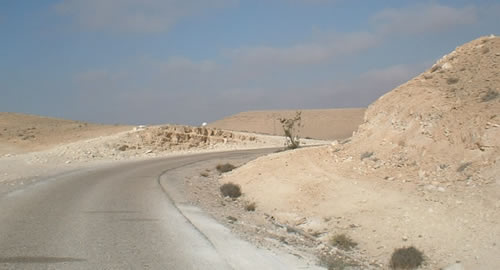 |
From this turn on the crest both can be seen: the Observatory in the West
and Mitzpe-Ramon in the East.
At first I had a bike, but as all my many bikes, it soon was stolen, and I
had to walk,
until we bought a jeep, for which the money was given to me by my oldest German
friend, Anke Ristenpart.
Still, there were many times, when I had to walk - the jeep was out of order,
or another team-worker needed it,
and when I made my lekh-lekha
as a hostess in 1994, I wanted to make a point of the Succayah's independence.
Except for a room in the office flat, I did not use anything from the Succayah,
including water and the car.
I bought a bike in order to go with it to the office every morning at 6, even
in winter, when it was still dark and frozen,
mainly in order to savor 45 minutes of talking to the
man I loved, which was possible only before his working hours.
Walking or riding this long distance, I was aware of Ups and Downs and every
turn in the road, even of the few bushes on its side.
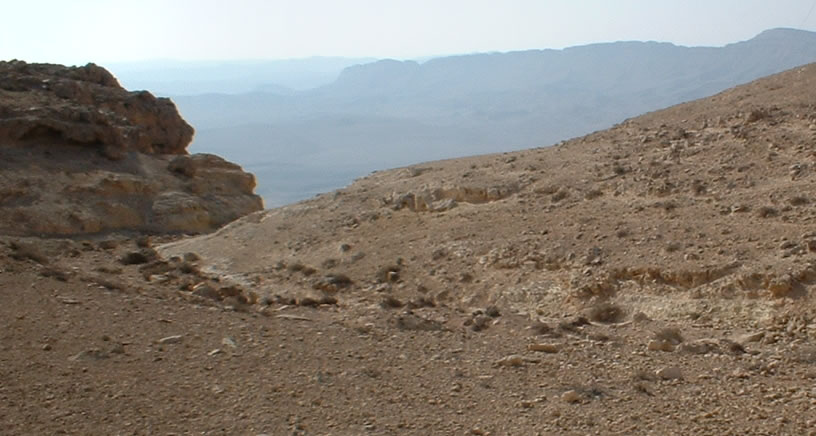
Riding or walking down the road brought me to this closest spot to the Crater.
Often the view was spectacular.
Sometimes I stopped the car and sat at the edge.
It was here, that during a hellish depression I threw my rage at God:
"Even death would not help me! Why is it impossible
to not exist? This is outrageously unfair."
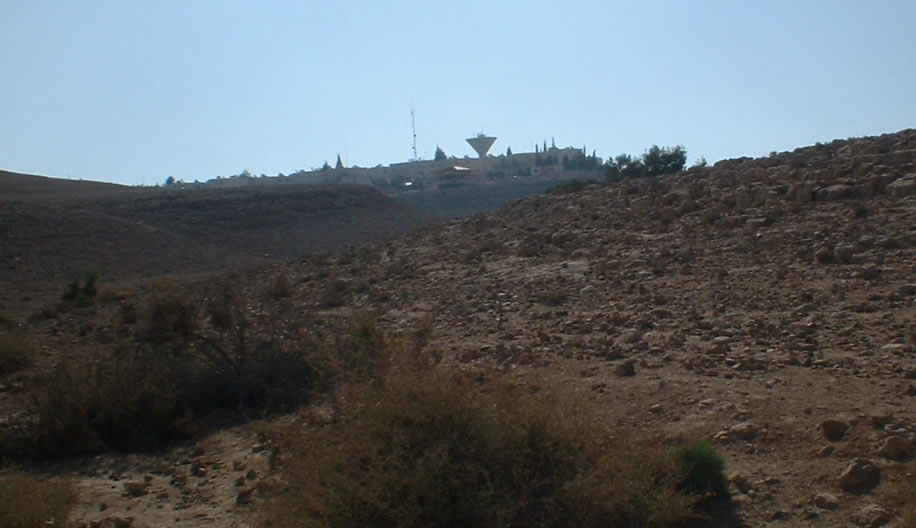
Finally I reach the little town, with its standard Israeli water tower, overlooking the Ramon Crater (invisible to the right)
Never before did my long walk or bike ride have this goal:
To prevent from my "partners" to sell out the Succah and themselves
to lawyers and courts.

September 9-10, 2012
| Exactly 10 years after
I began the Desert-Peace-Process
|
I continue to
listen to Haydn's
"Creation", [with English subtitles of the lyrics),
[it is the only video of a full performance,
I can find, but it's outrageous, that almost all Biblical passages about the
Creation are omitted].
while continuing to copy the chapter about
"THE
ORIGINS OF PAN, OR THE ORIGINAL OFFERING OF THE APPLE"
in the orange book,
and "THE ISLE" in the Indigo Book
|
|
The orange, 6th RUOW book [channeled by Ceanne de Rohan in 1995] 6 LAND OF PAN The Loss of Power and Magic on Earth Dedicated to The Father of Manifestation, that maligned, misunderstood, but essential Part of God |
The indigo, 8th
RUOW book [channeled by Ceanne de Rohan in 1995] 8 INDIGO - The Search for True Understanding and Balance Dedicated to The Four Parts of God in Loving Balance |
|
p.
206
|
p.206 These children did not know
how precarious the faeries' protection had become,
mostly because of them, and their parents did not
want to let them know this. The faerie king
had theatened withdrawal of his protection so many times around issues
involving the temple that they thought it was only another part of
the way he controlled their parents and did not believe they were
real threats anyway. The faeries
began to feel that they must dance now and try to dance
it out of themselves for their own sakes, but they feared it was going
to go into nature this way then and that that was not right. They
did not let themselves notice that nature already had this imprinting,
because they never saw the results of their not dancing and kept a
high level of light in nature around them. |
 |
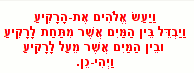
10:43
Nr. 2 Arie mit Chor
Nun schwanden vor dem heiligen Strahle 12:31
Chor Nr. 3 Rezitativ, Raphael , Nr.
5 Rezitativ, Raphael, Genesis
1:7 14: 23 Nr. 4 Chor mit Sopransolo, Gabriel Chor |
|
The orange, 6th RUOW book [channeled by Ceanne de Rohan in 1995] 6 LAND OF PAN The Loss of Power and Magic on Earth Dedicated to The Father of Manifestation, that maligned, misunderstood, but essential Part of God |
The indigo, 8th
RUOW book [channeled by Ceanne de Rohan in 1995] 8 INDIGO - The Search for True Understanding and Balance Dedicated to The Four Parts of God in Loving Balance |
|
p.
208 Many of these forms
were causing trouble, often more unseen than not, even farther back
in the woods, much of which didn't surface until
the last minute in Pan when Lucifer
came and took over their forms by moving consciousness
out of the power positions [????] and activating
imprinting. Many of these denials thought
they were going to get the help and power they wanted to have against
the parts they blamed and hated, and many of them did, but not
in the ways they thought or hoped for, since Lucifer
quickly overpowered and enslaved them also.
|
p.208 The faeries
did not know which way to fly. They seemed to be surrounded and did
not want to pass through the physical pressence of these men. They
wanted to fly high above them and get out of there, but they could
not gain enough speed from the place of slowed frightened
vibration they were in. They saw no choice
but to fly through these men who were closing in on them.They were
flying low through the woods, and some could not go high after that. |
 |
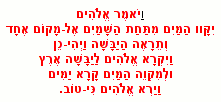
Nr.
5 Rezitativ, Raphael, Genesis
1:6-7 [missing in this performance ] Und Gott sprach: Es sammle sich
das Wasser 16:30 Nr.
6 - Arie Raphael |
|
The orange, 6th RUOW book [channeled by Ceanne de Rohan in 1995] 6 LAND OF PAN The Loss of Power and Magic on Earth Dedicated to The Father of Manifestation, that maligned, misunderstood, but essential Part of God |
The indigo, 8th
RUOW book [channeled by Ceanne de Rohan in 1995] 8 INDIGO - The Search for True Understanding and Balance Dedicated to The Four Parts of God in Loving Balance |
|
p.
210
|
p.210 They have never listened
to us; they have only pretended to!"
He was getting more and more agitated, flying up and down, back and
forth, almost as though he was going to run away from all of them
in that moment. |
 |
Nr. 7 Rezitativ , Gabriel, Genesis
1:11 Missing in this performance Und Gott sprach: 19:52
Nr. 8 Arie Sopran, Gabriel
|
|
The orange, 6th RUOW book [channeled by Ceanne de Rohan in 1995] 6 LAND OF PAN The Loss of Power and Magic on Earth Dedicated to The Father of Manifestation, that maligned, misunderstood, but essential Part of God |
The indigo, 8th
RUOW book [channeled by Ceanne de Rohan in 1995] 8 INDIGO - The Search for True Understanding and Balance Dedicated to The Four Parts of God in Loving Balance |
|
p.
212
|
p.212 know, Gwyn Ap Nudd,
the faerie king, took his faeries were [sic]
just suddenly not there anymore.
HEART ATTEMPTS "She did
manage |
 |
Nr. 9 Rezitativ, Uriel 24:28 Nr.
10 Chor |
|
The orange, 6th RUOW book [channeled by Ceanne de Rohan in 1995] 6 LAND OF PAN The Loss of Power and Magic on Earth Dedicated to The Father of Manifestation, that maligned, misunderstood, but essential Part of God |
The indigo, 8th
RUOW book [channeled by Ceanne de Rohan in 1995] 8 INDIGO - The Search for True Understanding and Balance Dedicated to The Four Parts of God in Loving Balance |
|
p.
214
|
p.214 in
the Mary and Jesus scenario there, "Many pieces of the Mother, "They thought this was
the solution, "They had little understanding
of the Will presence " So did I, because Heart
presence was Mary had nothing to say about this. No matter what bloodlines he claimed
When she found out Mary was beginning She liked having all of the
light She did not like hearing that her
baby was special in any way she was not married to him, "Before
anyone incarnated there, We
still did not understand fragmentation, I did not think it could be possible
anymore, after Delphi, |
 |
Nr. 11
Rezitativ , Uriel, Genesis
1, 14-16 [missing]
Und Gott sprach: 28:00 Nr.
12 Rezitativ, URIEL |
|
The orange, 6th RUOW book [channeled by Ceanne de Rohan in 1995] 6 LAND OF PAN The Loss of Power and Magic on Earth Dedicated to The Father of Manifestation, that maligned, misunderstood, but essential Part of God |
The indigo, 8th
RUOW book [channeled by Ceanne de Rohan in 1995] 8 INDIGO - The Search for True Understanding and Balance Dedicated to The Four Parts of God in Loving Balance |
Continuation of the two books in "Desert Vision>Altneuland"
| But
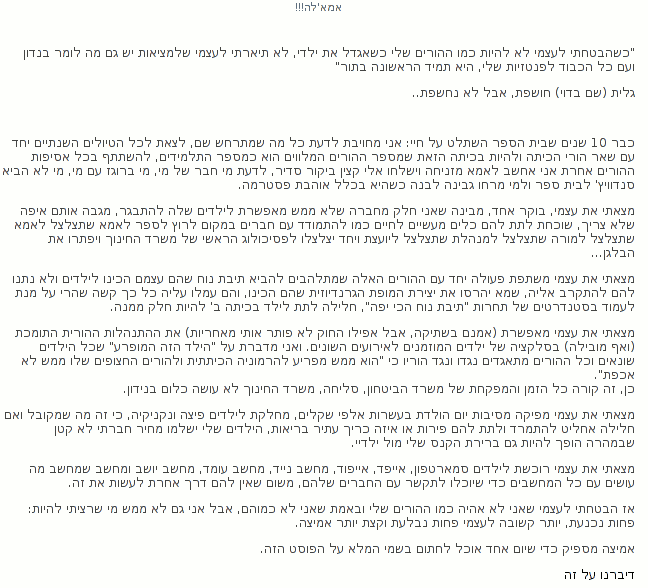
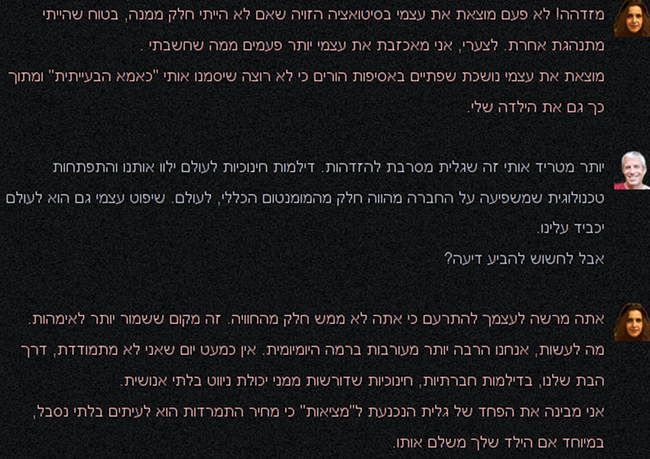
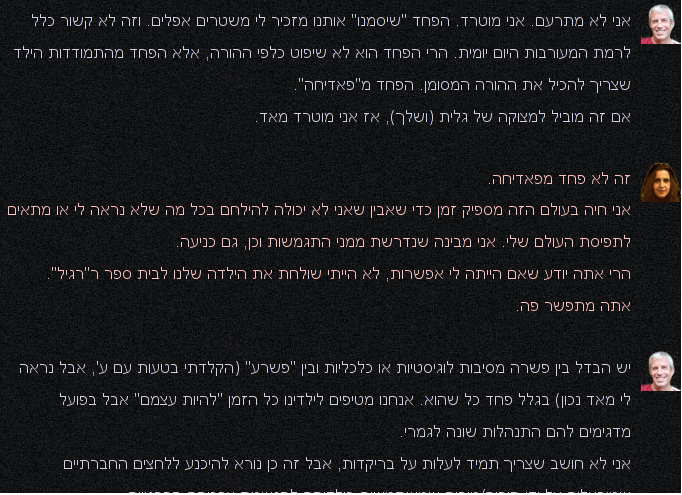
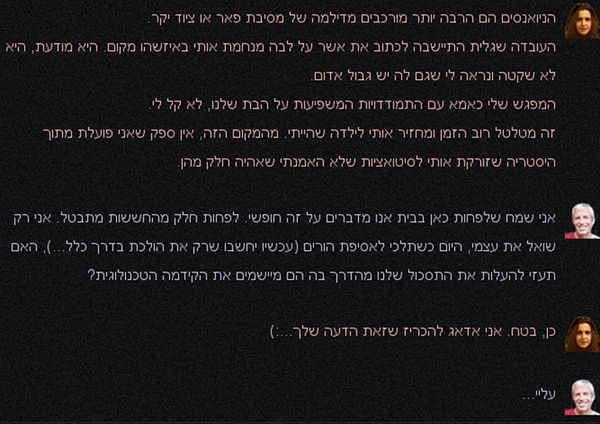
even if what "happens" is nothing "really dramatic", not something for the media, in any case, the situation between people is like it was then at the court of the mother on Earth. While tears were already in my eyes, I received an announcement about a contribution on the twosome blog of my children, from a mother, who in all her ten years of "children at school" did not gather the courage to publish her pain under her name. The response of Immanuel and Efrat is not less painful, because their dialog brings painfully to light the torment of a mother concerning the social acceptance of her child at school, the constant competition between the parents and the children, and the horror of making "fadikhot" (an Arab word, which became slang in the Hebrew language: "embarrassing failure, faux pas, blunder, stupid or careless mistake") i.e. actions or behavior of the parent that put the child to shame or so s/he believes. Where is redemption from all this????????????????????/ |
 |
 |
 |
| A
message from "Veronica" on Sept. 10, 2012 Your Future "We are often asked for predictions of the linear future. It is always of interest to us the lack of knowledge surrounding the subject. The ideas of fate or predetermined dramas with solid results are inaccurate ones at best. Since we have been linear the idea of destiny is not foreign. However, in our current perspective the idea of a choice-less predestined life falls flat in our idea of living. This would be a great robbery of individual thought and soulful evolution. From our memory the best lives lived were the ones where our choices garnered extreme experience. Each moment of decision a great gift that resulted in a life well done. |
 |
 |
Of course there is an energy that creates probabilities that are planned by yourselves that result in your future, but it's the choices you make that result in your future. What does this do? Why it creates your path [sic], custom designed to your specifications. It is therefore critically important to you as a manifest energy to choose with clarity as you proceed through your linear. The future is your tapestry. Choose wisely." --VERONICA |
|
The orange, 6th RUOW book [channeled by Ceanne de Rohan in 1995] 6 LAND OF PAN The Loss of Power and Magic on Earth Dedicated to The Father of Manifestation, that maligned, misunderstood, but essential Part of God |
The indigo, 8th
RUOW book [channeled by Ceanne de Rohan in 1995] 8 INDIGO - The Search for True Understanding and Balance Dedicated to The Four Parts of God in Loving Balance |
Continuation of the two books in "Desert Vision>Altneuland"